Showing posts with label service bus. Show all posts

Thursday, 11 June 2020

Malta 2014

Malta ~ A return ticket.


Much has been written in recent months about the public transport turmoil on the island of Malta. Would it be better or worse than twenty-six years ago? All those years ago the 'iconic' grey and red buses provided a haphazard, erratic service, timetables indicating the existence of a service rather than a schedule. To put the operating environment in context, Malta is an island smaller than the Isle of Wight with a population of approximately 413,000 of which 30,000 live on Gozo and it derives 35% of its GDP from tourism.


 Valletta Bus Station on first visit.

Stepping out of Luqa airport the initial signs were not good. The airport is served by seven routes, six are a series of X routes connecting the airport to major destinations throughout the island and the seventh, 201 is a minibus route to Rabat (Mdina) via the Blue Grotto. With the exception of X1 all services were operated under contract to Malta Public Transport by many of the island independents with an assortment of minibuses, buses and coaches in a multitude of liveries and showing signs of many years in service. More impressive was the infrastructure, the grumpy assistant behind the former Arriva information desk issued a euro 6.50 weekly travel card (since the demise of Arriva this ticket no longer covers Gozo which requires the purchase of a euro 1.50 day rider). Outside all the bus stop flags had route numbers with final destinations clearly shown and timetables for all routes.


Once away from the airport the situation is much improved. The majority of vehicles are in Arriva livery and staff are in smart Malta Public Transport uniforms. Public information is clear and concise in a format familiar to UK travellers, being produced by FWT. A full colour A4 route map of both islands is freely available, but timetable booklets are not produced, although information is readily available on the internet before arrival and by SMS once on the island, neither of which is necessary as all bus stops on the islands have timetables, route numbers and final destination on the flag. Valletta bus station has an information kiosk with route maps and stand departures information adorning the exterior walls, Sliema ferries interchange has a simalar Kiosk and Gozo has a new four bay bus station. On street ticket machine are located at various locations, although they never seem to be used, this could be because of the difficulty in reading the screens in bright sunlight, most passengers elect to pay the driver.


An Arriva King Long in Valletta bus station.

Routes from Valletta and Victoria(Rabat) Gozo are planned on a hub and spoke system with groupings of route numbers following major arterial roads, e.g. 51,52, 53 Valletta - Rabat(Mdina), and then splitting off to suburbs or rural villages, often in one way loops, reminiscent of First Bus in this country, 51 to Imtarfa, 52 Dingli, 53 Rabat suburbs. Each service is on a thirty-minute headway providing a ten-minute interval along the main corridor. Services operate from early morning until late night Monday to Saturday with a slight reduction on some routes on Sundays. Night routes operate between Valletta and Sliema, and Marsaxlokk receives a Sunday only X85 service to cover heavy tourist loadings leaving the 85 with capacity for the locals. Timetables are adhered to and schedules allow for sedate progress on the route. Driving standards have greatly improved, passengers no longer cross themselves when boarding and buses no longer carry an image of the virgin Mary.


Before discussing the buses and making any conclusions on their condition, it is worthwhile briefly looking at the condition of Maltese roads. They fall into three standards; short lengths of modern highway with smooth tarmac, generally paid for by the EU; urban streets with some rough lengths, not dissimilar from the worst roads in Britain, and finally rural roads, best described as potholes occasionally connected with tarmac. The majority of vehicles operated by Malta Public Transport are King Longs, either 9-meter XMQ6900J or 12-meter XMQ6127J. Although these represent the current offering from King Long, and are all low floor, they do not match standards normally associated with most European manufactures. Rough engines and mis-matched gearboxes give a ride reminiscent of an AEC Swift or Bristol RE. The exterior bodywork on the first deliveries is showing signs of quite severe rusting, whilst the interiors look worn and in need of refurbishment on all the fleet, and the much heralded air conditioning has given up with windows and roof vents being open. Would any European manufactured vehicles stand the rigors of such intensive utilisation and high passenger numbers? Passenger loadings are on a level we would associate with London or Hong Kong and vehicles operate for eighteen plus hours a day. One redeeming feature is the telematics. Large continually scrolling screens are fitted on all vehicles and display bi-lingual route direction and next stop information in Malti and English, although the volume of the associated audio announcements is set to low to be audible. The King Long fleet is supplemented on Gozo by an Optare Solo Hybrid and on Malta by a small number of BMC Falcons, Optare Solo Hybrids, Saracakis bodied Volvo B7RLE and Scarnif bodied MANs.


Independent operator in Valletta bus station.

In a desperate move to cover the withdraw of ex London Mercedes-Benz artics, Malta Public Transport contracted former independents to cover several routes and provide peek hour additions to other routes. Routes covered in their entirety by independents are X2; X3; X4; X5 and X7, all providing cross island services focused on the airport. Vehicles used are a mix of full size buses and coaches, including former Reading Transport YN56 FBF, Scania Omnicity still in Vodafone red and with full Reading legal lettering, now operated by Peppin Transport. Some of these vehicles carry ticket machines provided by the transport authority, although no attempt is made to collect revenue or check tickets. Three minibus routes are also covered, the 201 Airport - Blue Grotto - Rabat(Mdina) and the combined 101/102 Ghajn - Mellieha - Cirkewwa, all services are hourly. None of the vehicles carry a ticket machine, and again no attempt is made to collect revenue or check tickets, and the timetable has a more liberal interpretation. The 201 is proving problematic as the Blue Grotto is a major tourist attraction and only nineteen seats per hour are provided in each direction with no standing allowed, although we did manage twenty-four seated passengers on one occasion. Passengers between terminus points are left standing at stops with no alternative, and this was out-of-season.


In April 2014 the Maltese government issued an update statement. It confirms a leasing agreement for forty-three new air-conditioned buses. There has been three expressions of interest in taking over the operating franchise, two from local Maltese companies and one from the Spanish subsidiary of National Express. UK operators McGills and National Express have already dismissed any involvement, citing lack of transparency on the part of the Maltese government. The Government also reported a further 7% drop in revenue between January and March 2014.


Optare Solo in Gozo.

So is the situation any better than twenty six years ago? The answer is a most definitely yes. Whilst many may bemoan the loss of the iconic Maltese bus, like the Routemaster in London, they had no place in a modern, intense transport operation. Some areas still need addressing; driver communication skills with passengers are sadly lacking; revenue enforcement; vehicle maintenance, occasional roadside breakdowns were noted and the aroma of hot oil and diesel not uncommon; Valletta bus station requires the finishing touches, removal of the portacabins and inclusion of stands 16 and 17 into the main concourse, three of the fifteen stands have already been demolished by drivers overshooting the stop ramps and need repairing, finally, Cirkewwa terminus needs the finishing touches, currently being devoid of marked bays despite being the third busiest interchange. The management of Malta Public Transport are doing a sterling job in the face of intense political interference. The island now has a recognisable modern network with reliable timetables and buses, driven by professional well trained staff. Arriva should be proud of its legacy, just don't mention the artics. 

Bus and Coach World


Friday, 16 November 2018

Peru 2018


Strike, Rattle and Ride ~ Peru 2018.

When it comes to early morning wake-up calls, an earthquake with a magnitude of 5.7 at 6.07am is certainly an encouragement to get out of bed and thus began our first morning in Peru. On the plus side was the opportunity to watch rush-hour buses in Lima as life continued as normal. As with most modern cities, Lima suffers from chronic traffic congestion despite a high frequency bus network and modern BRT line. There are 15,396 buses registered in Lima by numerous independent operators, typically using smaller van/truck derived chassis and the larger of these have locally built bodies. The local authority, Municipalidad de Lima, oversees the Sistema Integrado de Transporte on routes in the 200/300s and the Metropolitano BRT with its four lines.


Stretching from Matellini in the south to Naranjal in the north the 'Metropolitano' is the most convenient for tourists as line C connects the tourist district of Miraflores and the old city, whilst lines A and B require one change. The full system is 21 miles in length and has 38 stations. Stations have network maps at the entrance as not all routes go the full distance or call at all stations. One inconvenience for visitors is the need to acquire a pre-purchase smartcard and load it with cash. The local advice was to stand at the entrance barrier with 2.50 new soles, the cost of a single fare, and ask a local to 'tap' you through in exchange for the cash, and it worked. The terminal at Naranjal provides the best location for observing all varieties of operators and vehicle types. The district of Miraflores has four Metropolitano stations with Ricardo Palma providing the least hazardous connection to local buses which congregate around the Ovalo and Central Park and only requires crossing one major road. The disadvantage with this location from an enthusiast’s perspective is the lack of American style school buses which are still prevalent on local service in the centre of Lima.


Lima has attempted to integrate the various independent long distance bus operators in the Grand Terminal, at Plaza Norte close to Metropolitano station Tomds Valle, but several still insist in managing their own departure points, such as Cruz del Sur on Avenue Javier Prado which is the departure point for the seventeen hour 629 mile trip along the Pacific coast to Arequipa. Arequipa is a tourist mecca with the historic centre built in a grid system of narrow one-way streets on one bank of the Rio Chilli, whilst the modern sprawling suburbs sit on the other bank and extend for miles along the highway thanks to the wealth generated by mining. The majority of bus routes from both areas pass through the Puente Grau bus station, with small van derived vehicles covering the narrow old streets and the occasional conventional bus crossing the bridge from the modern side. The bus station consist of two rows of stops on two levels and is heavily congested with dwell time rigorously enforced by transport inspectors. The occasional full size tourist coach penetrates the old city but the only large buses to do so are the unwieldy looking Ashok Leyland/Marcopolo double-deckers on sightseeing duties.


The next two days of our tour were aboard a Mercedes Benz with Irizar i6 body on an excursion from Arequipa (7550ft above sea level) to the Colca Canyon and Condors' Cross via Mirador De Los Volcanes (16,000ft above sea level) and a descent of 14 hairpin bends and numerous twists with a journey time of 4 hours to the town of Chivay (12,000ft above sea level). Whilst the Mercedes handled the altitude without any problems, older express buses on the route struggled: radiator grills lifted, engine covers propped open and a thick black trail of exhaust fumes left in their wake.


Continuing on to Puno, gateway to Lake Titicaca, the majority of express buses tended to be three-axel single deckers with Scania chassis and Marcopolo bodies. The route passes through Juliac, the provincial capital and transport hub, which is currently without a completed road bypass and its narrow streets are congested with van derived minibuses and Moto Taxis (tuk tuks). The road into Puno is steep with the main residential area sitting on the slopes above the bay whilst the main commercial and university areas sit along the lake shore. The local bus network is dominated by van derived minibuses plying their trade around the bay and the extent of the network is defined by two large tourist hotels on opposite headlands. 


From Puno we cheated and made the journey to Cusco by overnight train. This was fortuitous as it turned out because a planned day of national strikes meant that the road system in and out of Cusco was severely disrupted. Our planned train arrival time was brought forward by one-and-a-half-hours to circumvent any potential problems which the train company feared may include level crossings being blocked by protestors. The view of the express coach station from the train showed a large number of coaches standing idle as were the local city buses. By mid-morning, tourist coaches were either trapped in the city or unable to enter because main roads were blocked by rubble and oil drums, and the police increased their weapons from side-arms and riot shields to additional rifles and teargas launchers - a situation which lasted until 4pm. Eventually the all clear was given and we boarded our small VW badged MAN 'truck with Modasa (Motores Diesel Andinos S.A.) Apolo body and left the valley in a convoy of vehicles, driving through a slalom of rubble, oil drums etc. As we crested the hill there was a long convoy of express coaches waiting to enter the city. It soon became apparent that small truck derived coaches do not make comfortable express vehicles on steep winding roads and we arrived in the Sacred Valley amidst plumes of smoke coming from the brake pads. No such problems for German tourists staying in the hotel as their smart German registered Neoplan Cityliner, belonging to Worldwide Gruppenreisen of Dachau, Munich, sat proudly in the car park. According to the driver, German clientele demand luxury so the coach is shipped to South America for a year and makes regular journeys from Santiago, Chile through Boliva and across Peru, under the Andino Tours branding.


If you want to continue further along the Scared Valley the only options available are walking or train. When the train from Sacred Valley arrives at the town of  Aguas Calientes (gateway to Machu Picchu), Mercedes Benz Lo915's with Marcopolo or Volare W9 bodies transfer you to the citadel entrance. This is via a dirt road with a climb of 390 metres and thirteen hairpin bends, passing on route the depot for the operator Consettur Machupicchu S.A.C.


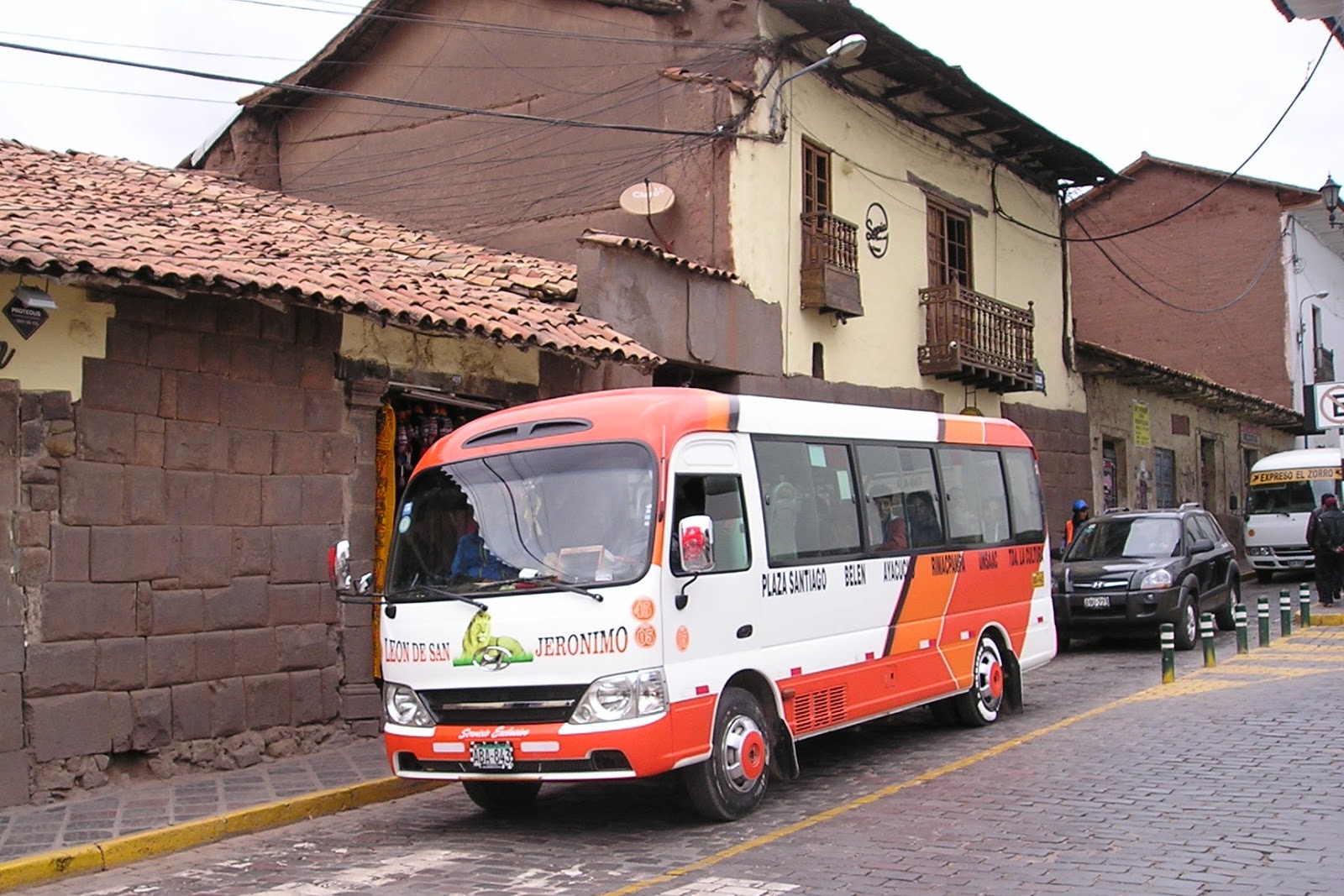
What a difference three days can make! Returning to Cusco from Machu Picchu, the city was alive with a fully functioning  bus service and vibrant coach station. The narrow one way streets are plied by small van and truck derived buses with individual operators such as Batman, Servicio Andino, Satelite and El Dorado with the route displayed along the side of the bodywork. Most routes run through the old city to modern sprawling suburbs on either side with mini interchange points such as City Park Limacpampa and Calle Concebidayoc doted around. The coach interchange is located ten blocks from the centre at Terminal Terrestre (Earth Terminal), a functional single story concrete building containing all the operators' individual  booking  kiosks and passenger seating area. Externally there are fifteen boarding bays and a vast parking area for coaches on layover. Micaela Bastidas which overlooks the interchange and runs parallel to the railway line is used by many operators as a parking area and houses a roadside depot for Transportes Power. For the final leg of the trip back to Lima, there were two route options. The first, generally considered the safest but longest, was to return via Arequipa, but that entailed travelling over many miles of previously travelled roads. So option two, a direct and spectacular route over the Andes covering 680 miles in 22 hours, was chosen. 


With dramatic scenery and interesting history Peru is well worth a visit, although with questionable driving and problems breathing at high altitude, it is literarily not a country for the faint hearted.   


Sunday, 2 September 2018

Vietnam & Cambodia 2015

Vietnam & Cambodia 2015 
These two countries are linked by history, having been part of one empire, also colonised by the French and ultimately being dragged into war with the Americans. Whilst Vietnam is developing rapidly, Cambodia remains some fifteen years behind, due primarily to the brief but brutal rule of the Khmer Rouge.

Vietnam’s public transport systems are patchy. Where they exist they tend to be very efficient, but not all major cities have one, and it appears to depend upon the local politicians’ priorities. Cambodia has a less developed system, instead having a love affair with the car. However what both countries have is an efficient express network both nationally and internationally.

Vietnam has two major bus builders. Thaco began in 2006, with a production line at Chu Lai -Truong Hai. Technology, engine and chassis assembly is obtained from the Hyundai Group. Saigon Transportation Mechanical Corporation (SAMCO) is a State-owned enterprise manufacturing and assembling buses and special purpose trucks on bare chassis imported from Isuzu, Mitsubishi, Mercedes-Benz, Hino, and Daewoo.


Spot the difference. On the left a Hyundai Aero Express Hi-Class and on the right, one badged as built by Thaco. 

Buses in Hanoi are operated by Transerco Hanoibus, a consortium of sixteen companies and can be recognized by the typical livery with three main colours: white, red and yellow. Each bus has a number in red, centered in a white circle and made visible in the front sign of the bus. The price of a bus ticket in Hanoi is from 5,000 to 10,000 VND dong (there are 32,000 Vietnamese Dong to the £) depending on the distance. Tickets are handed out by a conductor and you have to pay in cash.


Above: A Daewoo operated by Bac Ha as part of the Hanoi network.

There are more than 30 companies registered in Ho Chi Minh City (Saigon) to operate public transport with over 2,500 buses on more than 115 routes to all districts and to nearby provinces Dong Nai, Binh Duong, Tay Ninh and Long An.The price for a bus ticket fluctuates between 3,000 and 10,000 VND, depending on the distances and the type of buses.


Three Saigon buses. top, a Hyundai: middle, unknown and bottom, a Samco.

Buses might not be as crowded as those in Hanoi, but the problem is the quality and reliability of the services.  Moreover, the distances between the bus stops are pretty far. The major terminus and interchange point within the city is close to the Ben Thanh Market.


Between Hanoi and Saigon stands the city of Nha Trang, a developing seaside resort popular with Russian fly-n-flop holiday makers. The City has a convenient public bus service with modern air-conditioned vehicles. There are six main routes, the 1st. departs from Dien Khanh and ends at Vinh Truong Street; the 2nd route from Dien Khanh, through Tran Phu and ends at Binh Tan; the 3rd route from the South Bus Station to the North Bus Station; the 4th route from Duong Hien Quyen Street through Nguyen Thien Thuat and ends at Cau Da; the 5th route from Tran Phu bridge through To Hien Thanh and ends at Hon Ro 1; the 6th route from the South Bus Station to Luong Son Market.


A Samco dual door bus of Xe-Buyt, the Na Trang local service operator.  On route to Van Gia.


Coaches on ‘closed door’ tours operate with a driver and driver’s assistant who both appear to live in the underfloor lockers whilst away on tour. Luggage is sent ahead in a van.


A rare Mercedes Benz with the crew hanging out their washing in the locker.


Hyundai Universe Xpress in the Nha Trang depot. This is a sleeper coach with two decks of seats within a single decker coach body. Upper seats are reached by upright metal ladders. The 'Open Tour' refers to a scheduled express service. Luggage is often stored on the roof.

Cambodia

In Phnom Penh the municipality ran the routes until a private firm was contracted. Choice Taxi Company applied for the contract about two years ago, the company partnered with the municipality to run three bus lines.

The city has 50 buses, 40 recently arrived from South Korea for the bus lines. Global (Cambodia) Trade Development ran the original city route which ran along Monivong Boulevard, but the municipality pulled the firm’s contract, leaving City Hall to run the buses. Fares currently cost passengers 1,500 riel (approx 20p).

With all three routes in place, Phnom Penh has one line operating from Monivong Boulevard nine Kilometre  to Kdev Takuv pagoda, a second from the roundabout by the French Embassy on Monivong to Kandal province, and a third from Phnom Penh’s Night Market along the riverside to Dangkor district’s Choam Chao commune. Not quite what you would expect from a major capital city.


Above: A Hyundai at the Night Market terminus. Below: Another Hyundai heading for the centre.


Photographed in Siem Reap. The operator says it is a Volvo, the body looks like a Ayats copy.

Bus and Coach World