Showing posts with label buses. Show all posts

Tuesday, 3 October 2023

The Maritimes: Nova Scotia.


Acadian Lines 205, MCI 102-A3 in the Antigonish terminal adjacent to Highway 4 at 53 James St, 160 kilometres northeast of Halifax. Antigonish has a population of 4,656.

The Atlantic coast of Nova Scotia, Canada has weather conditions at the best of times described as changeable, however, in 2023 it was more biblical. As we stood at the bus stop, rain lashed down whilst just a few miles away and in the direct line of our bus route, wild fires raged. Having booked and paid for a pick-up (Coach Atlantic requires a minimum three hours’ booking notice), we had little choice but to travel. The omens were good, as our Ford E450 cutaway arrived on time from Lunenburg, having made an intermediate stop in Bridgewater. The service joined highway 103 for the remainder of the journey into Halifax, making just one stop on route at the Valerie Avenue car sharing park adjacent to the highway. On approach to the Halifax suburbs, the driver received a State Government warning message on his mobile devise advising him of impending road closures due to the proximity of the wild fires. Over the previous few days, we had become used to these messages appearing on tv screens and mobile phones: they let out a loud klaxon sound followed by the screen turning red and a warning message. The highway remained open for us, although the junctions off were closed and we soon arrived at the first city centre stop, a large edge of town shopping centre. Next stop, rather unusually, was the car park of a drive through burger restaurant, followed by the hospital and finally to the downtown terminus on Hollis Street, adjacent to the Via Rail station. In four decades of travelling this route, 2023 was exceptional although passenger transport in this part of Canada has seen its fair share of trials and tribulations.  


Left: Acadian Lines, a 1989 MCI MC-9 Special. Acadian had exclusive rights to operate on condition that the more profitable routes would subsidize the less profitable ones. Prince Edward Island had no regulations over the service, but in Nova Scotia and New Brunswick, it could take five to eight months to get permission for a fare or route change. In 2010 it applied to reduce service between Sydney and Halifax from three trips a day to two, its 51-seat coaches were carrying an average of 12 people. Right: Acadian Lines 205. MCI 102-A3 on highway 4 heading towards Cape Breton Island.
   

In August 1938 Nova Scotia Coach Lines, a division of United Service Corporation of Halifax, was formed. It was renamed Acadian Coach Lines in 1947. The coach company provided intercity and charter service within the province of Nova Scotia. In December 1955, Acadian Lines was purchased from United Service Corporation by George C. Thompson, Ralph A. Pepper, and Gordon H. Thompson. Expansion followed with the purchase of the bus operations of Fleetlines Limited of Halifax and Highland Lines of Sydney, the largest urban area on Cape Breton Island. Other associated companies have included including Acadian Travel Agency, Wagner Tours and McKenzie Bus Lines. By December 1995, the Irving Transportation Group subsidiary SMT (Eastern) had acquired Acadian Lines and its charter coach subsidiary Nova Charter Services. SMT (Eastern) Ltd was established in 1937 by K.C. Irving.

MacKenzie Bus Line No.30 MCI MC-5B at Lunenburg. MacKenzie Bus Line was a coach operator based in Bridgewater, Nova Scotia beginning operations in 1933 by transporting residents to and from Halifax. During the war years, there was a lack of available housing in Halifax and people moved to the surrounding area and Mackenzie’s thrived - in its heyday, carrying up to 100,000 passengers a year. A garage was established on York Street, Bridgewater: this was a former WWII aircraft hangar transferred from the north shore region of Annapolis Valley by means of a flatbed truck. In addition to the route from Halifax, the buses also ran between Bridgewater, Crescent Beach, Petite Riviere, as well as Riverport, Lunenburg, Mahone Bay, Hubbards, and Peggy's Cove. Unfortunately, by the early 1990s, low ridership eventually forced the company to discontinue its services along Nova Scotia's south shore between Halifax and Yarmouth via Bridgewater and ceased operations in 1998. De-licencing of the schedule service was granted by the Nova Scotia Government on September 23rd 1998. A short-term replacement was granted to DRL Coachlines Ltd.

By 2003 Acadian Lines now based in Moncton, New Brunswick operated intercity bus service between New Brunswick, Prince Edward Island and Nova Scotia. However, in 2004 Acadian Lines, now the largest intercity bus service in the Maritimes, once again changed ownership, being purchased by Orléans Express an intercity and charter coach operator based in Montréal, Québec, a subsidiary of Keolis Canada (formerly Groupe Orléans). In September 2009 Groupe Orléans reorganized and in August 2012, it was announced Acadian Lines would shut down as it was no longer deemed profitable, the company losing $12 million since the acquisition in 2004 and having recently seen 59 drivers, maintenance staff and customer agents vote to strike. Provincial statistics show that in 2009, 171,000 passengers were carried, down from 500,000 in 1986. By 2011, the numbers were down to 148,000. The last day of operations was November 30, 2012 with a loss of 120 jobs.


Left :Nova Charter Services 4763, MCI 102 C3 resting in downtown Halifax. Right: Nova Charter 4726, MCI MC9. Photographed at the Alexander Graham Bell National Historic Site, Baddeck, Cape Breton Island. Once a major destination for coach tours, locals now blame deteriorating roads on the Island for the lack of visitors.    

The next chapter of bus and coach operations in Nova Scotia would begin with Mike Cassidy, owner of Trius Tours in Charlottetown, Prince Edward Island, introducing the Maritime Bus brand on the 1st December 2012, picking up the services and promising a seamless transition. Trius Tours operate under various brands; Coach Atlantic; Prince Edward Tours; Gray Line and T3 (Take Transit Today) for local services in Charlottetown, Cornwall, Stratford, and Summerside, all on Prince Edward Island. Trius Tours was started by George Brookins in 1986. On April 1, 2005, Mike Cassidy and Bill Keith purchased Trius Tours from Brookins for $500,000. Keith soon sold his shares to Cassidy.  Brookins was hired as general manager. However, not all has been plain sailing and in 2010 Brookins was found guilty of defrauding the company of $203,728.90. 

SMT (Eastern) 4803, Setra S215 HDH waiting at the Caribou Ferry terminal on route Prince Edward Island. Before the opening of Confederation Bridge in 1997 this was one of two ferry crossings - the other being at Cape Tormentine closer to New Brunswick. 

During September 2019 Dennis Campbell, proprietor of Absolute Charters, sold out to Mike Cassidy. Mike Cassidy’s Group had a record year in 2019 with revenues reaching almost $45 million. The company had a fleet of 275 vehicles and employed 515 people across the Atlantic Maritimes. In April that year, the company carried 19,000 passengers. A year later, when Covid struck it carried only 650 people during the same month. Both 2020 and 2021 were disastrous for the Group, financial losses were reported of $33 million in 2020 and $25 million in 2021 as Transport Canada enforced a Covid cruise ship ban in the Maritimes. Things were looking up in May 2022 as Cassidy signed a contract with Prevost for the supply of 50 Prevost H3-45 coaches over a five-year period. In June 2022, 10 Prevost H3-45 were delivered. 


Left: Maritimebus Ford truck cutaway conversion photographed at the Catholic Church of St. Peter on Prince Edward Island, June 2015. The church stands next to the Confederation Bridge view point. The world's largest bridge over icy waters opened in 1997 joining Prince Edward Island to New Brunswick. Right: Coach Atlantic PR49187 a Ford cutaway at the Halifax terminal awaits the author for the return journey to Lunenburg. The service still operated a Covid timetable of three return journeys a week, although this was due to increase to five from July 2023. Two semi-retired drivers alternate week about to cover the service.   

In June 2023, we found Nova Scotia much quieter than previous occasions and compared to the 1980s and 1990s the range of express services and excursions on offer were greatly reduced. The focus is now on cruise ship passengers. 


Left: Ambassatours, seventy-four seat Van Hool Astromega photographed June 2019 at the Fisheries Museum of the Atlantic in Lunenburg. For visitors staying in the capital, Halifax, this is a popular destination as part of “Nova Scotia South Shore in a day” excursion. Right: Trius Tours Ltd 809, Setra S417 C56Ft fitted with Detroit Diesel Series 60 engine. The Company was founded in 1986 and is now part of the Coach Atlantic Group. Photographed at Peggy’s Cove information centre, rather than using the coach park at the lighthouse.


Left: Coach Atlantic 1901, MCI J4500 photographed June 2019. Maritime Bus does C$42 million in total sales, half of that is related to cruise ships and multi-day tours. Peggy’s Cove, just a short drive from Halifax, is the most popular destination for day tours with the coach park at the highest point, next to the lighthouse. Right: Absolute Charters 2006, MCI J4300. Absolute Charters (Ambassatours) had a temporary licence for twelve full size coaches between September and October 2018 providing services for cruise ship passengers. 2006 waits on the quay at the Fisheries Museum of the Atlantic in Lunenburg adorned with a livery depicting various sights along the South Shore.


Left: Coach Atlantic 1924, Prevost H3-45 dating from 2019. Photographed in a very wet downtown Halifax, having departed the Hollis Street terminus. 
Right: Coach Atlantic 1024 a Prevost X3-45 on the stand at the Halifax Terminal, 1161 Hollis Street, awaits passengers for the 3pm bound departure to Sydney, Cape Breton Island. 


Left: Rear view of Coach Atlantic 2030, Prevost H3-45. On route from Lunenburg to Halifax, passengers get the opportunity to visit Amos Pewter and take a stroll around Mahone Bay. Right: Trius Tours Prevost H Series in Charlottetown, Prince Edward Island. Covid proved a difficult time for the company. In Charlottetown where Maritime Bus has its depot, there were around 30 buses parked-up between early November 2019 and April 2021.

© Google Maps


Monday, 30 January 2023

Bus awards, worthwhile?


It is very seldom that I respond to other blog post, but a recent post from Roger French in his excellent Bus & Train User ( https://busandtrainuser.com/ ) got my hackles up. Not the general content, which as usual was insightful, but the reference to industry awards and in particular UK Bus Awards.

In November 2022 Blackpool Transport won bus operator of the year, which in my experience must be one of the least deserving companies I can think of. As I said in my response to the article, on a recent visit the buses were dirty and the staff non responsive to the passenger. The whole attitude of industry awards is one I find perplexing, is the travelling public convinced by the bus and coach industry blowing its own trumpet.

The UK Bus Awards website states ‘Panels of industry experts are examining the entries and making their judgement’. This perhaps highlights the blinkered nature of those within the industry, unable to see the product from the outside, customers perspective. Or is it an indictment of the recruitment policy for senior management within the passenger transport industry. Where once recruits had enthusiasm for their chosen careers, today selection comes from anybody who has achieved a degree, regardless of the subject matter, a manager is a manager, be it buses or burgers.

It is unfair to single out Blackpool, over the years awards have been given to many operators/managers who in the world are less than outstanding. What I find more difficult to comprehend is the number of categories within these awards, twenty-one in 2022. Everybody stands a chance of winning something, some categories make little sense whilst others award achievements that in reality have minimum effect on society or the environment. Why for instance reward an operator for environmental achievement that may involve half-a-dozen vehicles in a town or city that sees perhaps a hundred operating. Is it right to award one London bus driver for their work when the majority are lacklustre, would it not be more appropriate to reward a training environment that improves the whole sector, something the travelling public might see the benefit of.

One thing is for certain, no one will stand up and denounce any of these industry awards all the time they stand a chance of winning. Puffed out chest and trumpet blowing win out every time.


Friday, 9 September 2022

62° North – August 2022. The Faroe Islands

 62° North – August 2022 


RB 071 a Scania from the Rasmussen’s fleet travels along Hvalviksvegur on route to Saksun with passengers from local tour operator MB Tours. 

The Faroe Islands are a self-governing country of 18 islands, within the Kingdom of Denmark, set midway between Scotland and Iceland. The islands have a total population of 53,882 of which 22,878 live around the capital, Tórshavn on Streymoy island with the only other major conurbation being Klaksvík on Borðoy island with a population of 5,401. 

Bus services are clearly defined by livery. Red is the Bussleiðin network which operates the free city services in Tórshavn, and blue (the Bygdaleiðir network) operates between towns and villages. There are also five buses painted yellow that operate the community network in Klaksvík. A small band of private coach operators provide tourist and private hire services, many of these coaches appearing in Bygdaleiðir livery for operating tendered services on behalf of Strandfaraskip Landsins (SSL) the public transportation company belonging to the Ministry of Finance.

In the capital, the Bussleiðin network consists of seven routes offering a comprehensive day-time service with limited evening and Sunday operations. Most bus stops have timetables and easy to read network maps (fig 1). The Bygdaleiðir network is operated by a modern fleet of coaches and consists of 25 routes many with irregular timetables and route variations which make timetables difficult to understand. The network does however provide connectivity with feeder routes from smaller villages into the main road routes and links with the inter-island ferry services. 

The road infrastructure is excellent and the system of road tunnels amazing, including the now famous 11km long Eysturoy tunnel featuring the world’s first underwater roundabout complete with art installation and its own specially commissioned music. 


Gundurs Bussar operates the Tórshavn Bussleiðin on behalf of the Tórshavn municipality, the network having a PVR of 16 vehicles. AP 893 a Czech built SOR (SOR Libchavy spol. s r.o. Ltd.) BN model operating route 3. Photographed at the SMS shopping centre, the only edge-of-town shopping centre in the Faroe Islands. 

BN 954 heading out of the city on route 1. The nearside view of the SOR showing its semi-low floor twin door layout.

(fig 1) Bussleiðin bus stops have timetables and easy to read network maps.

Mouritsen’s Bussar BJ 828 Irizar i6s waiting in Gasadalurfor on Vágar island for the return of a pensioner group on a day out from Tórshavn.

HZ Bussar HU 934, Volvo 9900 parked in its hometown of Streymnes on Streymoy island, on what passes for a summer’s afternoon in the Faroe Islands. HZ is a small operator with just seven employees. 
 
HK Bussar HK 325 a Mercedes Benz Sprinter B17F new in 2015, sits at the Tjørnuvík terminal of Bygdaleiðir service 202. The five times a day service M-F only, plus two school day journeys from Oyrarbakki takes just 25 minutes and is designed to meet through service 400 Klaksvík – Tórshavn. Tjørnuvík is a seaside village with black sandy beach and a surf school set in a narrow inlet.


Former Bussleiðin SOR GB292 operating the shuttle bus service between Víkarnes and Tjørnuvík on Streymoy. The road down to the seaside village of Tjørnuvík clings to the cliff edge and, over the years, rock falls have reduced the width to single file so large vehicles are required to park at Víkarnes and use the park & ride. A set of traffic lights controls the flow of cars over a two-kilometre-long section of the road.

DS 053 Iveco Evadys of Landleiðin (Jón Thomasen). Standing at the Klaksvík terminus of Bygdaleiðir service 410, Fuglafjørður - Gøtudalur – Klaksvík, this is the Saturday/Sunday only 13.40 departure. The service feeds into connections at Gøtudali for onward journeys to Tórshavn using the 6.2km Nordoya tunnel.

The Landleiðin depot on the quayside in Klaksvík. RM 651 is an Iveco Daily whilst TD 415 and BF 055 are Iveco Magelys.

Landleiðin’s BF 055 Iveco Magelys in the Klaksvík depot on a Saturday afternoon. 

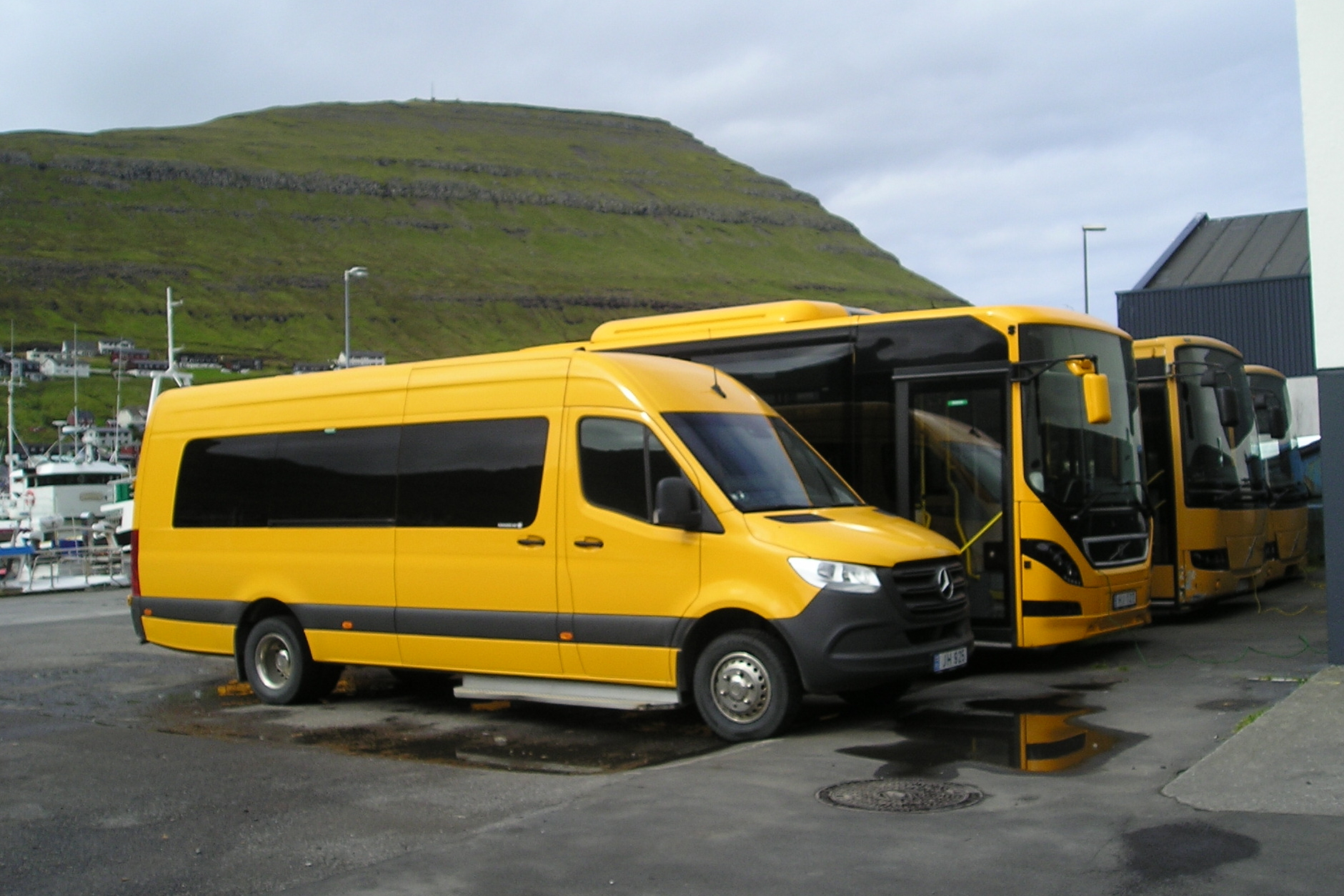
Klaksvík has its own fleet of five vehicles for town services operated by Askham. The fleet consist of two Mercedes Benz Sprinters and three Volvo full size buses. The two farthest from the camera were originally registered in 2012 to NFs Turistbusser in Holstebro (Denmark) and transferred to Askham’s in 2014. The one vehicle not in the photograph was parked in a residential area on the opposite side of the harbour, although no Saturday service appears to operate.

Sporting a personal registration Askham’s Volvo B12M-62 with Aabenraa 8500 body was new in 2002. Askham share the parking space on the Klaksvík quay with Landleiðin, although this view shows the bus parked across several bays of the public car park. 

HK Bussar HK 933 Volvo 9900 C53F new in 2019 operates a private hire journey for a visiting sports team.

Terminus in Tórshavn for the Bygdaleiðir network is on the quayside in front of the Smyril Line’s (Hirtshals, Denmark - Tórshavn, Faroe Islands – Seyðisfjørður, Iceland) ferry terminal. RB 740 is a Neoplan Tourliner from the Rasmuussen’s fleet. The quay is also served by Bussleiðin route 6.

BUSS 1 operated by Poulsen Bussar of Toftir is a MAN Lion’s coach. Heading out of Tórshavn on highway 10 having just departed the Smyrial terminal. Sitting atop the rock formation on the right is the Skansin fort and lighthouse.

HK Bussar HK 933 a Volvo 9713 C44F dating from 2012 is operating the airport shuttle into Tórshavn. This was the oldest vehicle seen on a regular express service. 


Thursday, 12 August 2021

Snowdon Sherpa


Croeso i Eryri

Situated at the top of Llanberis Pass is Pen-y-Pass bus interchange at an elevation of 359 metres (1,178 ft) – maybe the highest in Britain. Located in the Snowdonia National Park, which covers an area of 823 square miles and is home to over 26,000 people, Pen-y-Pass is the starting point for most walkers attempting to reach the summit of Snowdon (1,085 metres or 3,560 ft). The area is hugely popular and, consequently, parking and traffic congestion are major problems, more so in 2021 with staycations being the order of the day. To help placate the situation, the National Park and Gwynedd Council have, for many decades, supported a small network of bus routes known as the Snowdon Sherpa. Over the years, many operators have been involved: Express Motors, KMP, Padarn Bus, Arriva, GHA, O R Williams who traded as Whiteways, Crosville, and Alpine.


Geographically, the Snowdon Sherpa covers just a small area in the north west of the national park with the remainder of the park being covered by conventional bus and Traws Cymru services provided by operators such as Arriva, Llew Jones and Lloyds. In 2021 the entire Sherpa network is operated by Gwynfor Coaches of Gaerwen on the Isle of Anglesey, using a local base in Caernarfon. The network consists of six routes with five operating daily and the S6 operating weekends and bank holidays. The most popular route being the S1 between Llanberis and Pen-y-Pass, a relatively short journey of 5.5 miles. This route also acts as a park-and-ride service from Nant Peris, a small village five minutes outside Llanberis which has a large pay-and-display car park. From Monday to Friday this service operates on an hourly headway between 7.30am and 5pm, whilst on weekends and bank holidays the operation becomes far more intensive, starting at 6.45am and finishing at 6.50pm. On weekends and bank holidays, the hourly service from Llanberis is supplemented by two additional short workings per hour from the Nant Peris park-and-ride. Also departing Llanberis is the S2 on an hourly headway, giving this stretch of road to Pen-y-Pass a service every thirty-minutes. Unlike the S1, the S2 continues over the pass for another 11 miles to Betws-y-Coed and twice a day beyond that to Llanrwst.


Gwynfor Coaches KX15 BMV, an Optare Solo M710SE B19F which was new to Courtney ascends the A489 on service S4.

The third daily service, the S4, approaches Pen-y-Pass from the east by climbing the A489, having commenced in Caernarfon, but, unlike the S1 and S2 which are worked by double-deckers, uses Optare Solo’s to comply with width restrictions near the summit. Rather confusingly the S4, whilst marketed as part of the Sherpa network, is aimed more towards locals wanting to travel between Beddgelert and Caernarfon. To add further confusion for the visitor, some journeys on the S4 weekday timetable are shown as short workings, whereas in reality they continue to/from Beddgelert as S97 to Porthmadog. Sundays and bank holidays are made easier as both the S4 and S97 are shown on one timetable as a coordinated service. Beddgelert is a tourist destination in its own right and is a traditional village set beside two rivers, the Glaslyn and the Colwyn which meet at a picturesque bridge in the centre of the village. The Welsh Highland Railway coming from Porthmadog has a station in the village making it an ideal interchange with the bus, especially in 2021 as the station is also the terminus for the railway, the line onward to Caernarfon being out of action. 


Gwynfor Coaches YJ10 MBO an Optare Solo M780SE B27F, new to Heyfordian, descends from Pen-y-Pass on service S4.

Many bus routes in Britain contest the accolade of ‘most scenic’ but there can only be one winner of the ‘most scenic network’ - the Snowdon Sherpa. Dramatic landscapes viewed from the top deck of a bus as it clings to the mountain side and travels through lush, lake filled valleys take some beating. If you also factor in the ease of access by public transport into the network and the availability of several different good value travel cards from both rail and bus companies, Snowdonia National Park can be an enjoyable car free holiday.


Gwynfor Coaches LG52 DBU, DAF SDB250/Alexander H45/20D, new to Arriva London sits at the High Street lay-over point of service S1. The timetable shows the service starting from the interchange but on this journey the bus continued on a one-way loop along the A4086 and turning left into the High Street.


Gwynfor Coaches, on loan from Dawson Rentals, LK04 NME, a Volvo B7TL with Alexander H43/24D body, new to Metroline London Northern as VPL583. Seen loading at Llanberis interchange on the 12-noon departure of service S2 for Betws-y-Coed.


Gwynfor Coaches operating service 88 from Caernarfon with YJ61 JHV, an Optare Solo M780SE B27F which was new to Connect Transport. The service has just entered the High Street from the A4086 which runs parallel to the High Street acting as a by-pass. Gwynfor Coaches also operate the 85/86 from Bangor to Llanberis. All three services are frequent but have irregular headways. A more limited timetable operates on Sunday but has better clockface timings.

Llanberis, population 1,844, sits on the twin lakes of Llyn Padarn and Llyn Peris, and  the national park boundary dissects the town that today counts tourism as its main industry. Most of the attractions are centred on the southern end of the town: Snowdonia Mountain Railway, Llanberis lake railway, the wonderful Electric Mountain, and the National Slate Museum amongst others.


Monday, 1 March 2021

Border Offa’s variety. (A journey from Hereford in the south to Chester in the north)

 It is generally accepted that when you drive around Northern Ireland, at some stage, you will unknowingly cross the border into the Irish Republic. Usually, the first signs that you have done so are the petrol stations displaying prices in Euros: zig-zagging to and fro the two countries is just part of the day out. UK devolution has in a minor way brought about a similar situation on the mainland, although, until the outbreak of Covid 19, it has never been an issue or entered people’s consciousness. However, if you are near the English/mid-Welsh border, you may move in and out of each country whilst travelling along one road and the only indication that something might have changed is the language on the road signs.   Covid 19 and 2020 have brought the devolution issue into focus with each devolved power setting its own regulations and differing travel restrictions

In 2020, whilst travelling along the Shropshire/Powys border, a new road sign said  “Welsh covid rules apply on the right” - does that mean a driver needs to don a face mask before overtaking the car in front? That road sign set me thinking. How are operators along the meandering mid-Wales/Shropshire/Herefordshire border coping? If people look at a map of the area and think the border is reasonably straight, they are looking at the Offa’s Dyke long distance footpath and not the convoluted national border which weaves its way east/west on the way from south to north.  I have no answers to the operator question and I made no effort to engage with any depot staff to find one. I might have been travelling around but social distancing remained a priority, and the car was a safe haven. However, I thought it would be interesting to examine the issue from the comfort of my study/armchair.

Optare in Sargeants depot, Kington. 

Starting in the south with Sargeants Coaches of Kington, Herefordshire, in the eighteen months since my last visit, this fleet has undergone a major change. Out have gone several of the older coaches along with the Optare Excels and Tempos, and in have come newer Optare products, including a small batch of Metrocities - of the 20 vehicles 17 are buses. The town of Kington lies 3km east of the Welsh border with Sargeants being the only provider of bus services. Their primary service being the 461/462, Hereford-Kington-Llandrindod Wells, crossing the border just west of Kington. Whilst the focus is very much on Hereford, it being the only major conurbation for many miles around, Llandrindod Wells does offer a major interchange point for onward travel in Mid-Wales. The other core route for the company is the 41, operating two hourly between Kington and Knucklas, crossing the border at Presteigne. Apart from the first six kilometres, the majority of this service is on the Welsh side of the border, serving the two large Welsh communities of Presteigne and Knighton. Lady Hawkins is a large secondary school in Kington, with a wide catchment area, and Sargeants operate eight timetabled services into the school, six of which cross the border with service number 43 starting in England before continuing across the border, completing a long circular route and returning via a different border crossing point. These services must have been a nightmare in 2020 with both sides of the border having different school and community lockdowns.


The town of Presteigne with a population of 2,710 sits on a small outcrop of border just 1km wide that pokes into England. Apart from the aforementioned Sergeants bus service, the town also has a Monday only X11, Builth Wells-Ludlow cross border service operated by Celtic Travel. The town also has a secondary school attracting pupils from the surrounding rural area with two of the featured operators, Weale's Wheels of Llanddewi and Owens of Knighton providing services.

Weals's Wheels depot.

Weale's Wheels of Llanddewi has a depot in the heart of this small village from which it operates a fleet of fifteen coaches and minibuses of varying ages, the most modern being a Mercedes Benz Tourismo. The majority of contracts are centred along the A483/A44 corridor.  


Moving north to Knighton - a town that both sits on the border which more-or-less follows the river Teme at this point, and on the Offa’s Dyke trail. As previously mentioned, the town has a regular bus service provided by Sargeants, and it also has a Monday X11 service provided by Celtic Travel. Additionally, Arriva operate the 738/740 four days a week to Ludlow, meaning all routes serving the town originate in Wales and terminate in England. The town is home to Owens Motors, a fourth-generation family business tracing their history back to 1897 and currently operate a mixed fleet of twelve vehicles. The company is in a unique situation having an operator’s licence with a legal address in Wales whilst the depot is situated in England just a few yards up the road.

Owens depot, Knighton.

Staying on the English side of the border, heading north to the small Shropshire village of Newcastle, home to the depot of M&J Travel with a mixed fleet of twelve coaches. This is a typical coach operator offering private hire, UK holidays and school contracts on both sides of the border. The fleet is smart and always well presented. Quite how this company find their drivers when the number of houses in the village is almost identical to fleet size and there is no nearby sizeable town, on either side of the border, is a mystery.      


M&J Travel, depot.

If I had to define one operator at the centre of this article it would be Celtic Travel of Llanidloes, a town in the middle of Wales. The company is one of the largest independent coach/bus operators in mid Wales and currently operates 30+ vehicles of varying sizes, including TRN 662A, new to Barrow Corporation as CEO 952, and a 1958 Leyland PD2/Park Royal acquired from Mac Tours and still in their colours. It has two depots - one in the centre of Llanidloes and a larger maintenance depot on an industrial site south of the town. Nine bus services are currently operated including Traws Cymru X75 (Shrewsbury/Rhaeadr), however most originate around Builth Wells/Llandrindod Wells and extend north to Shrewsbury, west to Aberystwyth, east to Ludlow and Hereford, and south to Carmarthen. Whilst the coach operations cover an area boarded by Aberystwyth/Welshpool/Machynlleth/Brecon/M4 Magor services. 

Celtic Travel, Volvo/MCV.

Moving on north and crossing the border, just one mile back into England, is the depot of Minsterley Motors which is in the middle of nowhere at Pennerley. Another mixed bus/coach fleet of 30+ vehicles established for more than 50 years. Seven local bus services are operated, centred around Shrewsbury and Ludlow with one route extending across the border to Newtown, Powys. At this point the border takes a turn west and south before abruptly reversing direction and once again heading north. Here just inside the Welsh border we have Tanat Valley with two depots, half-a-mile apart, along the valley road leading to Llanrhaeadr-ym-Mochnant. 


Established in 1920 and still owned by the same family, Tanat Valley currently operate a mixed fleet of 44 vehicles, consisting of Optare products for the bus operations and DAF/Volvo/Mercedes for the coach fleet. Pride of the fleet is a 1962 Leyland Tiger Cub (YRC 194) with Alexander DP41F body, new in 1962 to Trent. This operator, probably more than any other independent along the English/Welsh border, makes its living equally from both countries. Oswestry, Shropshire being the nearest town is a focal point for many of the nine bus services currently operated including the Traws Cymru T12 to Machynlleth.  

Tanat Valley Leyland Tiger Cub.

North of Oswestry, it becomes primarily old Crosville territory and Arriva Midlands North crosses into Wales with the hourly 2 to Wrexham and finally reaches the northern limit of the Welsh border at Chester with the now much reduced, hourly Arriva Wales 1. Wrexham became a hot-bed of competition after deregulation with companies such as Wrights becoming a major provider for a short while. In more recent times GHA and D. Jones both made short lived incursions into the tendered service network, and both defeated by poor fiscal management and run-ins with the Traffic Commissioner. Today Pats Coaches is the only independent operator offering a cross border service, with the 146 to Whitchurch, a small market town just one mile into England. 

Arriva service 1 at Chester Railway Station.

This article is not the time for reviewing services from Chester, despite the city boundary being on the border. After the breakup of Crosville and deregulation, many smaller operators came and went. Today only one independent survives on services into Wales with the majority of routes being part of the Arriva Wales network. 


The 160 miles of the Anglo-Welsh border is a convoluted route. No one setting the boundary line in 1536 could have foreseen the two nations once again separating under devolution, but if Covid 19 continues, we might need to remember our passports when next boarding a bus.