Thursday, 27 June 2019

Sargeants Coaches


Sargeants on parade.


In deepest Herefordshire, tucked in a valley more familiar to Celts and Romans than modern day travellers, lies Kington which is a small town of 3200 souls and home to Sargeants Coaches.


As befits an operator of many years standing, the depot is very traditional, sitting alongside a public footpath and sharing a vehicle right-of-way with caravans using the adjacent campground. A single storey office fronts the depot with a maintenance shed immediately behind, then a yard and at the bottom is a steam cleaning ramp and wash area.


This is the type of depot I love as it brings back fond memories. No paved areas, just rough hardcore surface in-between a selection of various size potholes which are filled with rain water and a mixture of diesel and oil floating as if a flatten larva-lamp and hypnotic patterns gently drifting in the light breeze. Men in overalls that are coated in the grime of many days' labour are under well maintained vehicles, whilst others scrub and clean oblivious to the drenching they are receiving.


Small town operators with a loyal local staff are gradually becoming a rarity, may the survivors live long and prosper.


R399 EOS, new to Parks, Hamilton (KSK 950) and YIL 1720, new to Armchair (N713 CYC), both Volvo B10M-62 with Van Hool Alizee C53F bodies parked adjacent to the maintenance shed. 

W408 UCJ Optare Excel L1180 B43F was delivered new and now resides at the bottom of the yard close to the steam cleaning ramp.

The two guard dogs keep watch over Y877 PWT an Optare Solo M920 C31F, purchased new in 2001.

A line-up of Optare products.

YJ03 UMK DAF SDB250, Optare Spectra H47/27F new to Reading Buses in 2003.

YJ58 CFG, Optare Tempo X1200 B43F, the ex Optare demonstrator, gets a scrubbing.


YJ10 MHU Optare Solo M950 B31F originally delivered to Hatts in 2010 reverses out ready for the short two hundred yard drive into Kington bus station and the 13.10 departure on cross border route 461 to Llandrindod Wells.

FX03 ECC Mercedes Benz 1223L with Ferqei (Optare import) C39F body acquired from Hatts. 

(Never enter a depot without seeking permission and never board a vehicle unless invited to do so.)   

Wednesday, 30 January 2019

When the ships come in.


All aboard that's going ashore ~ Southampton cruise movements.


Yet another opportunity to look at the mass movement of passengers through the SOC area and one which is less obvious. For family reasons, during the summer of 2017 I have spent a great deal of time in Southampton, more than at any time since moving away thirty-one years ago. To make the most of this opportunity I planned, wherever possible, to coordinate these visits with days when there were major cruise ship movements.

Departing from bay 1 at Victoria Coach Station on Queen Mary 2 passenger transfer, Princess Coaches MA17 YJB, Scania K410EB4.


Southampton is Europe's largest 'turnaround' cruise ship port with 27.7% of the market, creating 11,000 (2014 figures) jobs in the south east region, with the total cruise ship industry estimated to be worth £1 billon to the UK economy. The city is home to the headquarters of Carnival UK, ultimate owners of P&O and Cunard. In 2016, 462 cruise ships and 1.8m passengers passed through the port. There is also an increasing market for the city from ships that call in as day visitors, giving the opportunity for shore excursions to Stonehenge, Salisbury, Winchester etc, whilst the city appears popular for shopping. The majority of ships whether on turnaround or visit arrive around 7am and depart between 4pm and 7pm the same day. 

Princess Coaches' drivers tend to use Mayflower Park for layovers. Front coach is DB09 PAB, Scania K340EB4 with Irizar C49Ft body. An unidentified cruise ship is moored in berth 101.
For many years the majority of local passenger and crew transfers were operated by Marchwood Motorways and this continued for quite some period after the Go-Ahead takeover. Passengers were shuttled between the various berths in both the eastern and western docks, and Southampton Central railway station, whilst the crew had a dedicated bus stop in Castle Way (the flag is still on the pole). This year the majority of local crew transfers were carried out by Princess Coaches using the coach bay in Harbour Parade as a terminus. This is also the location used for passengers making shore visits to the city centre. Various operators appear on passenger shuttles, by far the most prolific being Morton's of Little London, Basingstoke, using their fleet of three axial Volvo B9TL with either East Lancs of Optare Olympus CH61/39F bodies, ideally suited for this type of mass movement. Solent Coaches of Ringwood do local transfers using a pickup point in Castle Way between West Street and St Michael's Street, denoted by an 'A' board placed on the pavement. Solent Coaches regularly use three axial Neoplans and Volvos with Van Hool bodies, and these can often be found later in Hill Lane, operating King Edward VI school contracts.

Photographed 'resting' in the Herbert Walker Avenue coach bay, Solent Coaches Volvo B10M-62/Plaxton C52F body. New in 1997 to Eassons, Southampton. Previous registrations, DAZ5054 and WNR 63.
Other regular contract services include P&O crew transfers for those staff joining or leaving the ship in Southampton, and are operated by City Circle from Hayes in Middlesex. By far the largest operator into the port in terms of passenger numbers, vehicle size and fleet utilisation is Eavesway of Wigan. A familiar sight on the motorways of Britain, with their Van Hool TD921s, they have cornered the market in scheduled transfer services for all major cruise lines and ports. On behalf of Carnival Lines they operate four routes into Southampton: (a) Scotland and the North West, Glasgow, (03.30 departure, £138 return), via various pickup points, Blackpool, Liverpool, Stoke to Birmingham (10.15 departure, £75 return); (b) North East and Yorkshire, Newcastle (05.00 departure, £124 return), via Hull, Leeds, Northampton to Cherwell Valley Services (11am departure, £68 return); (c) North Wales, Bangor (05.15 depart, £115 return), via Abergele, to Chester (07.15 depart, £92 return), and finally (d) South Wales, Pont Abraham (07.45 depart, £92 return), via Cardiff to Swindon (12.00 depart, £72 return). Each service arrives into Southampton between 2.30pm and 3pm.

Resting between crew transfers in Herbert Walker Avenue, back to back City Circle coaches - a Neoplan and YT15 AUY, Scania K410EB6 with Irizar i6 C53Ft body.
The best time to view the comings and goings is between 2pm and 4pm on days when several ships are in port. This however will require a reasonable amount of walking and some luck, as four port gates are used, one in, one out for the eastern dock, one by Mayflower Park in the western dock and a second one near the Novotel. The distance between the furthest east and west is just under a mile. Sun is also a problem at all the gates, so try for an overcast day and, if you like coaches, you will love Southampton.

Returning to port from the Harbour Parade terminus, Morton's of Basingstoke Volvo B9TL with Optare Olympus H61/39F body. New to Imperial, Southall, London as YJ11 EMV.

A regular operator into the port is Crawley Luxury (Brown), West Sussex. BU14 SZK Mercedes Benz Tourismo. New to Chiltern Travel in 2014, exiting the dock gate onto Platform Road after dropping off at Queen Mary 2. The Queen Mary 2 is 149,215 tonnes, has 1253 crew and carries a maximum of 2695 passengers. 

All hands to the pump on busy days, First Bus Hampshire & Dorset Dennis Trident with East Lancs H49/30F body. New to First Bristol in 2000. Turning onto Town Quay after completing a city centre shuttle.

Unusual performer, Eavesway Travel Van Hool TDX21A CH52/5Ft, in an all over wrap for Nissan, laying over in Herbert Walker Avenue.

National Express Group, Clarkes of London. Mercedes Benz Tourismo C49Ft, new in 2010. Behind is P&O Azura, 115,055 tonnes with 900 cabins, 1226 crew and able to carry 3597 passengers.


Something of a rarity in private hire fleets, Acklams, Beverley YX16 NWH, Volvo B11RT with Plaxton Elite-i CH69/3Ft body turning into Town Quay.

Solent Coaches, Ringwood, 5505 ML, Neoplan N2216/3SHDL C61Ft. New in 2012 to Bennett, Uxbridge as MJ62 OMT. Entering Mayflower Roundabout returning excursion passengers to the ship.


Monday, 7 January 2019

One of England's best bus rides

One of England's best bus rides.

Late December may seem an odd time to ride a scenic route but on a clear day with few passengers what could be better.

840 Transdev Coastliner Leeds to Whitby. Timetable


Boarding a Volvo with Wrights body at Leeds Bus Station and sitting upstairs in one of the single armchair style seats with a clear view through one of the double glazed windows (no misting-up on wet days), the journey starts with an uninspiring plod through the hinterland of Leeds before the first burst of speed along the A64 then turning off into Tadcaster. Before reaching the heart of this small market town the route take a short diversion though a typical sixties housing estate. The town is dominated by the John Smiths Brewery and several of its pubs, once through the centre and over the river bridge, the service enters the small bus station. Before long the route re-joins the A64 until the outskirts of York.

York is not a city to dismiss by just taking a bus straight through, it has so much history with in the well preserved walls it deserves at least two days exploration. For today however a chance to stretch the legs and take refreshments on a two hour break. For a good value snack I recommend Baileys café or for a delicious breakfast try Brew and Brownie, both on Museum Street.  

Refreshed and back on the bus, the northern suburbs of York are left behind, replaced by flat farm land as the bus makes its way through narrow lanes before eventually joining the A64 and a swift run into Malton. Malton, 'home of the Coastliner' it proudly proclaims on the wall of the bus station which also acts as the depot with clear views into the garage from the top deck. Leaving the town through the narrow streets that lead on to the A169 and a short journey in the countryside before entering Pickering. Rather than entering the town centre, where the bus stops also act as a connection to the North Yorkshire Moors Railway the bus turns right and stops on the main road. After a short drive along the A170 the bus arrives at the beautiful village of Thornton-le-Dale where the bus stops are located in the centre of a small village green come roundabout, from where the bus makes a loop before taking a narrow road to commence the climb onto the Moors.  
From this point on the true joy of travelling on the top deck of a bus comes into its own. The North Yorkshire Moors open up in front of you as the road ungulates across the vast open space with Fylingdales radar station being one of the few signs of habitation. The coast comes into view just before the bus turns off the A169 and heads for Goathland via a steep narrow road over a single track bridge, past the railway station and up into the village centre. The bus continues through the village before making a 360° turn back to the village bus stop. This is a great jumping off point for walkers and home to the TV series Heartbeat, well worth spending time here on any other day. But, onward, the bus retraces the route back onto the A169 before starting the long decent down Blue Bank and turning right following the river through Esk Dale. At Briggswath as the bus turns left an old sign warns bus drivers to 'Stop and engage low gear' as the final climb towards Whitby begins.

Whitby is entered via a narrow descent onto the harbour front. The bus makes its final stop opposite the small bus station before disappearing to lay-over outside the Co-Op. A wonderful ride aboard a comfortable bus with superb driver. Plenty of time now to stretch the legs around this beautiful seaside town dominated by the Abbey. For a pleasant light meal or just a cup of tea I recommend the Seamans Mission just off the harbour wall in Haggersgate.

Ever onward. 

X93 Arriva Whitby to Scarborough. Timetable

The hourly service departs Whitby bus station and runs down the dramatic coastline via Robin Hood's Bay , where the National Park meets the coast and on into Scarborough. After the first leg of this trip, this journey comes as a bit of a shock. The bus was an ageing single decker Optare Solo with rough engine and mad driver, which rather spoiled the journey. Part of the reason for this swift journey is down to Arriva keeping the timetabled journey to under one hour, so only requiring two buses on the route. Despite the rapid ride we still arrived in Scarborough a few minutes late. The terminus is located on street adjacent to the railway station and just one stop down from the next departure point.

Scarborough is a pleasant traditional British seaside town split in two. The town centre where the bus stops has the normal high street stores, but beyond those after a steep decent you will find two wide sweeping bays.


843 Transdev Coastliner Scarborough to Leeds. Timetable      

The final leg of the day and it is back to the top deck and comfortable seats for a journey along the A64, with sweeping views across flat farmland towards the Moors. The road is busy but no delays are experienced and the bus arrives into Malton bus station on time. The remainder of the journey retraces this mornings route via York to Leeds. 

A grand day out.  


Wednesday, 28 November 2018

Kazakhstan & Kyrgyzstan 2018

Two weeks, two countries, two seasons. Kazakhstan & Kyrgyzstan 2018.


Arriving in Astana, the capital of Kazakhstan, in early October and the temperature is a pleasant 26°although the locals are wrapped-up against the cold. Just one of the unusual sights that are about to assault the senses in this futurist 'planned' city of one million inhabitants, living in the world’s largest landlocked country that is the size of India with the population of the Netherlands.
A new Iveco Hybrid emerges from the underpass in front of the opera house in Astana.

Work on designing Astana started just after independence in 1991, utilising the vast sparsely populated Central Steppes to replace the former crowded capital Almaty which is located in the south of the country. Despite being devoid of hills and having only one major river, the geology makes the city unsuitable for a subway and so the public transport network is solely reliant upon buses, although a monorail between the airport and railway station is currently under construction.
The only sighting of a bus in Astana not in corporate livery. There was no identifying operator name, chassis type or body manufacturer.

The oddly named 'Astana LRT' is responsible for 1,000 buses operating on 71 bus routes. Since 2014 the City has invested heavily in new buses and supporting infrastructure with aid from international banks. 214 buses were delivered in July 2015 followed by several hundred in the following three years. Much of the recent investment was linked to the international Expo17 held in the city during the summer of 2017. Iveco was appointed official supplier for Expo17 having already established a presence in the city by supplying 358 Citelis Euro V buses. In time for the Expo, 210 Urbanway and Urbanway Hybrids were delivered from the factory in Annonay, France, while the final assembly was carried out locally in Kostanay, at facilities belonging to Iveco Bus’s partner and distributor SaryarkaAutoProm.


An Astana Iveco Citelis, one of the deliveries for Expo 2017.

Support infrastructure also saw investment - a new depot, improved bus stops and travel cards have all been implemented. The city has 1065 bus stops, 82 of the busiest were upgraded to semi-enclosed with Wi-Fi connectivity and heating, essential when temperatures can plummet to -20 combined with heavy snow fall. In July 2018 new enter-and-exit rules began, boarding via the front door, exiting via any door  and cash fares became double the amount charged using the 'Transcard' smartcard system, currently a single fare using the card cost 90 tenge (approx US $0.26). 


Astana City Tours, Higer KLQ6119GS.


Almaty


Set around a dramatic backdrop of the Zailiysky Alatau mountains, the former capital Almaty is the largest city in Kazakhstan, with a population of 2,029,800. The city is comprised of beautiful tree lined avenues in a grid formation, fed by a modern motorway network that brings people in from the surrounding plains and also leads to chronic traffic congestion. The public transport system consists of one subway route with 9 stations, 8 trolleybus routes and 110 bus routes. Bus routes are numbered 1 to 205 with route 3 operating 24hr from the airport, whilst trolleybus routes are numbered 1 to 25.
An overloaded  PAZ-320302-11-CNG climbs Dostyk Avenue on route 5. 

In the late 1990s public transport passed to 48 private operators operating 3,304 buses. Today that figure is 13 private companies and 1 municipal operator, Almaty Electrotrans, together operating 1,535 buses and 200 trolleybuses. Approximately 800 of the buses are CNG powered, some converted from diesel other purchased new. 2010/11 saw 200 new CNG deliveries with further deliveries from Daewoo (GDW6126HGNE model) and Yutong (ZK6120HGM model) in subsequent years. The trolleybus network has also seen regular investment although it has currently stalled, and there are 200 modern Neoplan YoungMan JNP6120GDZ operating which have all been delivered since 2008.


Trolleybus 3013, a Neoplan Youngman JNP6120GDZ, sits at the central market on a late Sunday afternoon.

Once again a smartcard, the 'Onay', is available reducing the fare from 150 tenge cash to 80 tenge. Surprisingly, conductors are still used on some services and they carry a hand held scanner to supplement the one fitted beside the driver cab. If time only permits just one bus journey, it is worth hopping on a number 12, with a peak-time headway of seven minutes, departing from the Kazakhstan Hotel in the city centre and climbing 899m in 14.5km through the city's most affluent suburbs to the terminus at Medeu. This is the world’s largest high mountain ice skating rink and is the gateway into the Shymbulak Ski Resort, passing through the city's most affluent suburbs on route.
A Russian built GAZ LiAZ 5292 laying over at the Medeu ice stadium, the terminus of route 12, having climbed 899m in 14.5km from the city centre.
Before heading to either Sairan or Sayakhat, the two bus stations with inter-regional departures, it is worth reflecting on Almaty's prominence in the local bus building industry. In 2007 Daewoo Bus Kazakhstan LLP opened a factory and 2019 production is expected to be between 300 and 400 units. 2016 saw the launch by Higer and Parasat of a project for producing electric buses and in 2018 Euracom Group GmbH opened a facility that can build 100 electric buses per year.
                  Attempting to attract city sightseeing passengers at Medeu ice stadium is an 18m Eurabus from German manufacturer Euracom Group. Euracom has built a factory in Almaty to assemble upwards of 100 vehicles a year from German kits. The 18m articulated version has a theoretical range of 650km. 


Shymkent         

This is third most populous city in Kazakhstan after Almaty and Astana with a population of 1,002,291.The city has aspirations to attract more tourists whilst continuing to develop as a regional centre. Two double-deck tourist buses were delivered in 2015, purchased by Zhibek Zholy, but to outsiders there seems little to attract visitors beyond a Soviet era centre and Kazak modernism, although they do have a liking for all things London red like buses, phone boxes etc. 
Coming out of the early morning gloom in Shymkent are Green Bus Company Golden Dragon YC6G260N-30 CNG and a Zhengzhou Yutong also CNG powered.

The city has 74 bus routes with a vast array of express services operated by 27 companies, including an international route to Tashkent in Uzbekistan which takes three hours to cover the 145 kilometres. Many operators use the large 'Abtotypak' on the north western side of the city. The majority of local buses are provided by the Green Bus Company which was established in Shymkent during 2014. The company has a fleet of 200 relatively new Yutong and Golden Dragon built vehicles running on CNG.

 
One of the few older buses operating in Shymkent is this MAN on Respublika Avenue, route 26.   

The reason for staying in Shymkent is to use the city as a gateway for visiting the historical sites at Otrar and Turkistan (a city not another country despite its name), both are points along the original Silk Road, about 2 1/2 hours and 600 tenge drive away. Turkistan has a modest bus terminus in the city centre with local operators using a motley selection of Mercedes Benz 0405s, Russian PAZ, Chinese FAW and van derived marshrutkas.
These small yellow and white minibuses can be found on many Shymkent bus routes. Whilst there is no manufacturer’s name, the grill badge does resemble Chinese manufacturer Liao Ning.

Departing Kazakhstan for Bishkek, the capital of Kyrgyzstan, the journey is best made by air due to the state of the roads. 

Bishkek 

Arriving in the capital, it becomes immediately apparent that the country is less developed than Kazakhstan. The city has an older more established Soviet feel to it which is enhanced by the aging fleet of trolleybuses plying the streets. There are 11 bus, 8 trolleybus and 115 marshrutkas routes with bus fares costing eight som and  marshrutkas ten som. (approx US $0.14).
 
Bishkek trolleybus 1603, a 2008 Belkommunmash AKSM-321, on Moskovskaya Street.


A Chongqing Hengtong CKZ6116NA4 CNG powered bus on Bishkek city route 35 laying over at the central railway station.

In 2018 the city created one transport body under local government control with the aim of speeding up the modernisation of the network which had commenced in 2013 with the arrival of forty-four new trolleybuses. Trolleybus deliveries have come from Belkommunmash OJSC in Belarus and Russian manufacturer Trolza (formally Ziu) who are the current favoured suppliers with fifty-two 5275.03 Optima's due in service by the end of 2019. Work to modernise the marshrutkas network has also taken place, removing many of the older Mercedes Benz 207D's from the streets with replacements between 2009 and 2013, via China Aid, coming from Yangzhou Yaxing Motor Coach Co., Ltd.(now Asiastar). More recent deliveries in 2017 were Chinese built Chongqing Hengtong CKZ6116NA4 CNG powered buses for city centre circular route 35 which also serves the railway station. 
On route to the Chinese border, the Issyk-Kul area is home to many Uighurs peoples, and in a typical town the marshrutkas gather in the bus terminus.
Moving on from the city to experience the natural wonders of this country is relatively simple as the country has an extensive network of marshrutkus routes. This mode of transport does however require stamina and one long day in what was a Mercedes Benz Sprinter van conversion with upright seats was more than enough on this holiday. Thankfully there are tourist coaches and these tend to be old Setra's with the occasional Mercedes Benz and are well suited to the rough roads. Heading east there is little in the way of major conurbations after Tokmok, and major tourist destinations such as Issyk Kul, the world’s second largest alpine lake and the ski resorts around the regional capital of Karakol are mainly catered for by the dreaded white minibuses.
 Neoplan Cityliner N116 on Intourist transfer duties at Bishkek airport.
  
The easy option for the homeward journey was a flight back to Astana, where the temperature had gone from a barmy summer 26° to a wintery -2° with a blizzard blowing. Perhaps the weather is a good analogy for the transport in these two countries. Kazakhstan is enjoying an early summer of new buses and modern route systems whilst Kyrgyzstan is still emerging from a long soviet winter with lack of resources to invest in a modern transport network.


Friday, 16 November 2018

Peru 2018


Strike, Rattle and Ride ~ Peru 2018.

When it comes to early morning wake-up calls, an earthquake with a magnitude of 5.7 at 6.07am is certainly an encouragement to get out of bed and thus began our first morning in Peru. On the plus side was the opportunity to watch rush-hour buses in Lima as life continued as normal. As with most modern cities, Lima suffers from chronic traffic congestion despite a high frequency bus network and modern BRT line. There are 15,396 buses registered in Lima by numerous independent operators, typically using smaller van/truck derived chassis and the larger of these have locally built bodies. The local authority, Municipalidad de Lima, oversees the Sistema Integrado de Transporte on routes in the 200/300s and the Metropolitano BRT with its four lines.


Stretching from Matellini in the south to Naranjal in the north the 'Metropolitano' is the most convenient for tourists as line C connects the tourist district of Miraflores and the old city, whilst lines A and B require one change. The full system is 21 miles in length and has 38 stations. Stations have network maps at the entrance as not all routes go the full distance or call at all stations. One inconvenience for visitors is the need to acquire a pre-purchase smartcard and load it with cash. The local advice was to stand at the entrance barrier with 2.50 new soles, the cost of a single fare, and ask a local to 'tap' you through in exchange for the cash, and it worked. The terminal at Naranjal provides the best location for observing all varieties of operators and vehicle types. The district of Miraflores has four Metropolitano stations with Ricardo Palma providing the least hazardous connection to local buses which congregate around the Ovalo and Central Park and only requires crossing one major road. The disadvantage with this location from an enthusiast’s perspective is the lack of American style school buses which are still prevalent on local service in the centre of Lima.


Lima has attempted to integrate the various independent long distance bus operators in the Grand Terminal, at Plaza Norte close to Metropolitano station Tomds Valle, but several still insist in managing their own departure points, such as Cruz del Sur on Avenue Javier Prado which is the departure point for the seventeen hour 629 mile trip along the Pacific coast to Arequipa. Arequipa is a tourist mecca with the historic centre built in a grid system of narrow one-way streets on one bank of the Rio Chilli, whilst the modern sprawling suburbs sit on the other bank and extend for miles along the highway thanks to the wealth generated by mining. The majority of bus routes from both areas pass through the Puente Grau bus station, with small van derived vehicles covering the narrow old streets and the occasional conventional bus crossing the bridge from the modern side. The bus station consist of two rows of stops on two levels and is heavily congested with dwell time rigorously enforced by transport inspectors. The occasional full size tourist coach penetrates the old city but the only large buses to do so are the unwieldy looking Ashok Leyland/Marcopolo double-deckers on sightseeing duties.


The next two days of our tour were aboard a Mercedes Benz with Irizar i6 body on an excursion from Arequipa (7550ft above sea level) to the Colca Canyon and Condors' Cross via Mirador De Los Volcanes (16,000ft above sea level) and a descent of 14 hairpin bends and numerous twists with a journey time of 4 hours to the town of Chivay (12,000ft above sea level). Whilst the Mercedes handled the altitude without any problems, older express buses on the route struggled: radiator grills lifted, engine covers propped open and a thick black trail of exhaust fumes left in their wake.


Continuing on to Puno, gateway to Lake Titicaca, the majority of express buses tended to be three-axel single deckers with Scania chassis and Marcopolo bodies. The route passes through Juliac, the provincial capital and transport hub, which is currently without a completed road bypass and its narrow streets are congested with van derived minibuses and Moto Taxis (tuk tuks). The road into Puno is steep with the main residential area sitting on the slopes above the bay whilst the main commercial and university areas sit along the lake shore. The local bus network is dominated by van derived minibuses plying their trade around the bay and the extent of the network is defined by two large tourist hotels on opposite headlands. 


From Puno we cheated and made the journey to Cusco by overnight train. This was fortuitous as it turned out because a planned day of national strikes meant that the road system in and out of Cusco was severely disrupted. Our planned train arrival time was brought forward by one-and-a-half-hours to circumvent any potential problems which the train company feared may include level crossings being blocked by protestors. The view of the express coach station from the train showed a large number of coaches standing idle as were the local city buses. By mid-morning, tourist coaches were either trapped in the city or unable to enter because main roads were blocked by rubble and oil drums, and the police increased their weapons from side-arms and riot shields to additional rifles and teargas launchers - a situation which lasted until 4pm. Eventually the all clear was given and we boarded our small VW badged MAN 'truck with Modasa (Motores Diesel Andinos S.A.) Apolo body and left the valley in a convoy of vehicles, driving through a slalom of rubble, oil drums etc. As we crested the hill there was a long convoy of express coaches waiting to enter the city. It soon became apparent that small truck derived coaches do not make comfortable express vehicles on steep winding roads and we arrived in the Sacred Valley amidst plumes of smoke coming from the brake pads. No such problems for German tourists staying in the hotel as their smart German registered Neoplan Cityliner, belonging to Worldwide Gruppenreisen of Dachau, Munich, sat proudly in the car park. According to the driver, German clientele demand luxury so the coach is shipped to South America for a year and makes regular journeys from Santiago, Chile through Boliva and across Peru, under the Andino Tours branding.


If you want to continue further along the Scared Valley the only options available are walking or train. When the train from Sacred Valley arrives at the town of  Aguas Calientes (gateway to Machu Picchu), Mercedes Benz Lo915's with Marcopolo or Volare W9 bodies transfer you to the citadel entrance. This is via a dirt road with a climb of 390 metres and thirteen hairpin bends, passing on route the depot for the operator Consettur Machupicchu S.A.C.


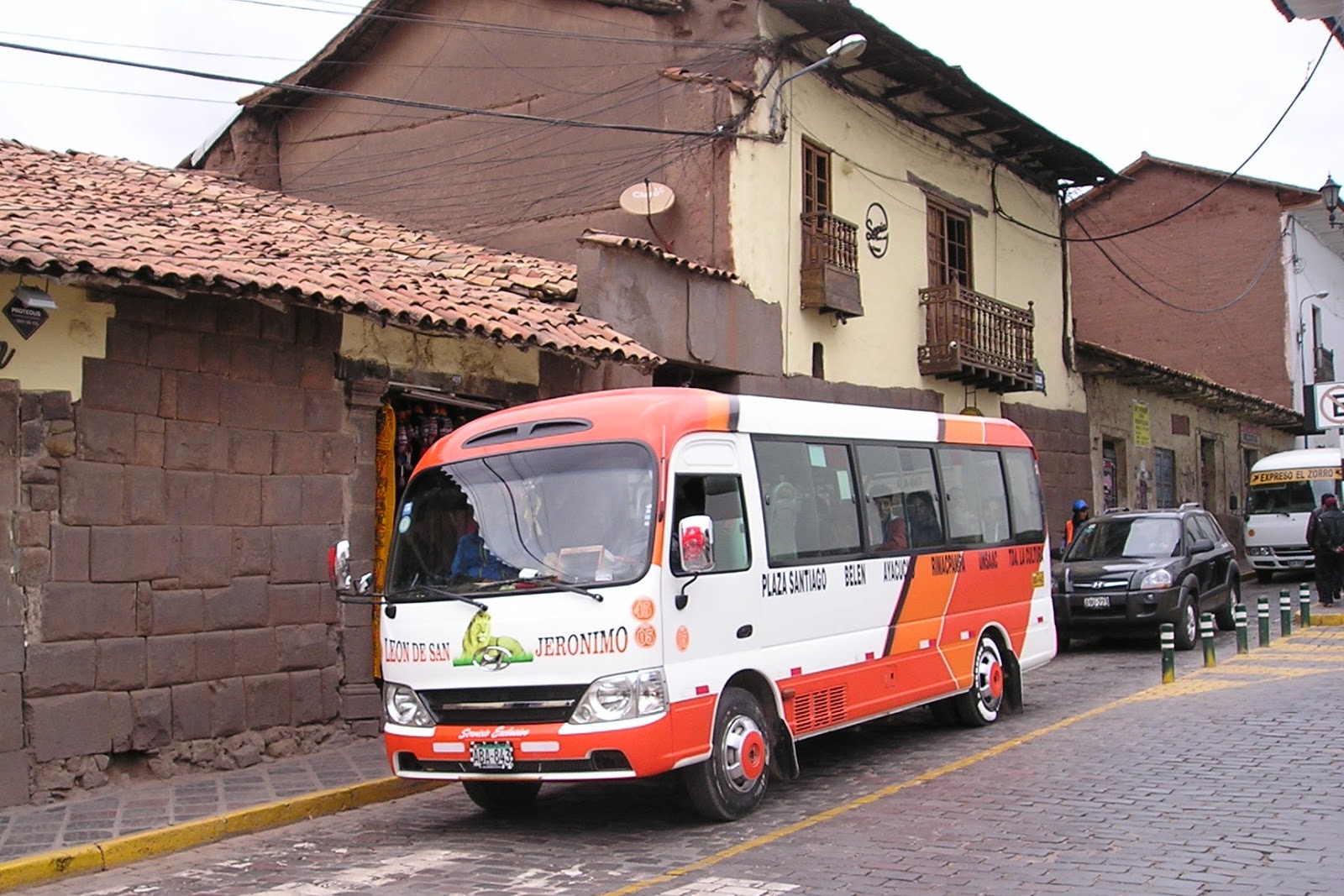
What a difference three days can make! Returning to Cusco from Machu Picchu, the city was alive with a fully functioning  bus service and vibrant coach station. The narrow one way streets are plied by small van and truck derived buses with individual operators such as Batman, Servicio Andino, Satelite and El Dorado with the route displayed along the side of the bodywork. Most routes run through the old city to modern sprawling suburbs on either side with mini interchange points such as City Park Limacpampa and Calle Concebidayoc doted around. The coach interchange is located ten blocks from the centre at Terminal Terrestre (Earth Terminal), a functional single story concrete building containing all the operators' individual  booking  kiosks and passenger seating area. Externally there are fifteen boarding bays and a vast parking area for coaches on layover. Micaela Bastidas which overlooks the interchange and runs parallel to the railway line is used by many operators as a parking area and houses a roadside depot for Transportes Power. For the final leg of the trip back to Lima, there were two route options. The first, generally considered the safest but longest, was to return via Arequipa, but that entailed travelling over many miles of previously travelled roads. So option two, a direct and spectacular route over the Andes covering 680 miles in 22 hours, was chosen. 


With dramatic scenery and interesting history Peru is well worth a visit, although with questionable driving and problems breathing at high altitude, it is literarily not a country for the faint hearted.