Friday, 17 January 2020

Seville 2019


Seville, the capital of Andalusia, is situated on the lower reaches of the Guadalquivir River and is the fourth-largest city in Spain with a population of 705,325. The transport network is under the management of TUSSAM (Transportes Urbanos de Sevilla, Sociedad AnĂ³nima Municipal), a public company established in 1975 and belonging to the City. 


TUSSAM 170, 7934 FSV a CNG fuelled Irisbus 491E.12.27 CityClass with Noge Cittour body, new in 2007, operating route 34 on the narrow one-way Calle Trajano.
Currently 441 buses are operated with an additional 17 provided by contractors, between them carrying 81,497,883 passengers and covering 12.7m kilometres per annum. In the past year 43 new buses were delivered, of which 35 were 12m long and fitted with CNG (compressed natural gas) engines, and 8 were 10.5m long. The average age of the fleet stands at 9.6 years and by 2020, it is anticipated that 300 buses will be CNG powered. CNG powered buses were first introduced in 2009 and now account for 67% of the annual mileage, the remainder still relies on conventional diesel propulsion.

TUSSAM 1912, 8979 KFK Man NL 313F CNG with Castrosua CS40 City Versus II body in Plaza del Duque, on route 13.
The city has an extensive bus network of forty-six routes, most buses leaving from either Puerta de Jerez in the south of the city centre or Plaza Ponce de Leon in the east, and generally operate between 6 am and 11.30 pm. Popular with tourist are the circular services: C3 and C4 follow the ring road around the old city centre and C5, operated by a Mercedes Benz Sprinter, takes a circular route inside the old city. Tickets cost 1.40 euros per trip bought onboard, alternatively the rechargable Tarjeta Multiviaje travel card is available reducing the cost and can also be used on the tram.Opened in 2007, the single tram route (Metrocentro) T1 is the only public transport available to visitors entering the historical centre of the city around the cathedral and Royal Alcazar. It is just 2.2km long with five stops, and is operated by five CAF Urbos 3 articulated trams fitted with supercapacitors that allow for 2/3rds of the route to be operated catenary free. A rapid charge point is located on the platform outside the cathedral main entrance. Trams previously ran in Seville from 1866 until 1965.

TUSSAM tram 304 with the pantograph down sits under the rapid charge point on Avenue de la Constitucion. The five Urbos 3 articulated trams manufactured by CAF and delivered in 2011 run in battery mode on the catenary free section.
Located on the banks of the Guadalquivir River, Plaza de Armas Bus Station is the focal point for long distance express services. It was built in 1991 as part of the Expo92 infrastructure and, since 2010, has been managed by the Metropolitan Transportation Consortium of the Seville Area. The station has 43 platforms with 1,500 arrivals and departures per day carrying 17,000 passengers on vehicles operated by 20 companies, DAMAS and ALSA being the most prominent. Thirty-six routes operate within the Metropolitan area with numerous national and international routes extending as far as Romania and Morocco. For those interested in trams, a restored car from the original Seville network sits on the main concourse.

DAMAS 1746 KW a Volvo B7BLE with Sunsundegui Astral body departs Plaza de Armas Bus Station on service 174 to Gines, a twenty minute journey to the west of Seville.
A final point of interest for bus enthusiasts is, unusually, the city sightseeing tours particularly those operated by Sevirama using former Nottingham Corporation East Lancs bodied Leyland Atlantean AN68/1Rs. Five are operated and these are supplemented by SE-6277-DL (JPE 233V), a former London Country Leyland Atlantean with Roe body, and two Volvo B9TL/Unvi Urbis 2.5 double-deckers. The Atlanteans were originally imported by Guide Friday in 2002 having been converted to open-top.
Sevirama British Fleet

New To
Fleet No.
Original Registration
Chassis
Chassis No.
Body
Body No.
Original Seating
Current Seating
Current Registration
Previous Registration
Nottingham
598
GVO 718N
Leyland AN68/1R
7403880
East Lancs
4013
H47/31D
O47/29C
SE-0032-BX

Nottingham
572
OTO 572M
Leyland AN68/1R
7302665
East Lancs
2534
H47/30D
O47/29C
SE-4063-BU
SE-2211-R2
Nottingham
575
OTO 575M
Leyland AN68/1R
7304430
East Lancs
2536
H47/30D
O47/29C
SE-4064-BU
SE-2213-R2
Nottingham
592
GTO 332N
Leyland AN68/1R
7404624
East Lancs
4007
H47/31D
O47/29C
SE-4065-BU
SE-2212-R2
Nottingham
591
GCR 881N
Leyland AN68/1R
7404342
East Lancs
4006
H47/31D
O47/29C
SE-4066-BU
SE-2214-R2
London Country
AN233
JPE 233V
Leyland AN68B/1R
7905103
Roe
GO
8287
H43/30F
O43/30C
SE-6277-DL


Sevirama SE-4065-BU, former Nottingham Leyland Atlantean GTO 332N stands at Plaza del Duque de la Victoria. Following close behind is a Volvo B9TL/Unvi Urbis of Compania Hispalense de Transvias in City Sightseeing colours.
Competition for sightseeing business is provided by 'Compania Hispalense de Transvias' operating the City Sightseeing franchise using modern Volvos with Unvi and Ayats bodies. Although reports suggest that they also operate two former British double-deckers, both MCW Metrobuses supplied by Ensignbus were new to London Transport (GYE 386W and WYW 61T), sadly neither were in evidence during the visit.  


DAMAS 453, 8318 KGS, Iveco Magelys PRO 12.2m, VIN VNE7257RX00002195, new in 2017. The DAMAS business originates from the 1920s when it first transported passengers between Ayamonte and Huelva. Today the business is the largest coach and bus company in Huelva province. Currently six national routes and one international route (Lagos, Portugal) are operated from Plaza de Armas Bus Station.
     

Seville is more than just oranges. A split city with the old centre located on the east bank and the modern heart located around the still very much in tact Expo92 site on the west bank, it provides plenty of opportunities for the casual visitor and transport enthusiast.


ALSA 3020, 7379 HBH, Mercedes Benz Travego 17RHD (WEB63224713102887), new in 2010, sits at traffic lights about to turn into Calle Torneo, having just departed  Plaza de Armas Bus Station. The destination blind shows route licence VJA-160 for service M-364.

ALSA Spain became part of the British owned National Express Group in 2005. The company can trace its history back to the 18th century but it wasn’t until 1923 the company Automobiles Luarca, SA (ALSA) was formed. Today it has a modern fleet of 3,465 buses, 9,719 staff and transport more than 358 million passengers per year.


TUSSAM 1056, Castrosua bodied Iveco Cityclass on Avenue Carlos V. The tram overhead wires are visible in the background on the segregated track, within a few yards the tram crosses a roundabout and the overhead wires cease.

TUSSAM 2475 KPS Mercedes Benz Sprinter City 65.77 in Plaza del Duque, on route C5 a circular route inside the old city.

Saturday, 28 December 2019

A day away from York.

Leaving York for the day.

As a visitor to York there can be very few reasons for wanting to leave this beautiful city with all of the history contained within the wall. There comes a time however to explore and this bus trip is one of the more unusual.

With three lengthy journeys today a hearty breakfast is called for, I recommend Baileys cafe and tea rooms for quick and cheap or Brew and Brownie for the pancakes, both on Museum Street. It is then a short walk to Piccadilly for the 10am departure of East Yorkshire service number X46 to Hull.
On this occasion we have a Volvo with MCV body offering a very comfortable ride. The X46 follows A1079 for much of the journey, leaving York via Walmgate it is several miles before the first turning off into the village of Pocklington. The main bus stop is located in the East Yorkshire bus depot, a mere shadow of its former glory, an edifice to the heyday of the bus.

Back on the main road the countryside is flat but from the top deck you get far reaching view toward the North Yorkshire Moors. Market Weighton a small unremarkable town provides the next diversion from the A1079 before continuing to beautiful market town of Beverley, dominated by the Minster, the Anglican church built around the tomb of John, Bishop of York. For bus enthusiast sadly the route into and out of the town no longer passes through the 'Bar' but navigates the small inner ring road into the bus station, where a short layover takes place.

Leaving Beverley through the new sprawling housing estates, Hull comes into view across the bleak flat fields that divide the two communities. The X46 takes a convoluted route through Hull city centre venturing down to the rejuvenated water front before heading into the modern bus station adjacent to the railway station. Arriving here gives the opportunity for bus photography in the layover area behind the departure bays and easy access into Hull city centre. 


3.15pm at Stand D in Hull bus station is the vital timing point on this journey, it is the final weekday departure of Stagecoach X62 (simpliExpress) to Leeds. Originally envisaged as a coach service the double-deckers now operating the route still use the coach bays in Hull and Leeds bus stations.
X62
Leaving Hull on the A63 along the Humber shoreline the first of what will be many diversions away from the direct route happens at North Ferriby followed quickly by a trip through Brough before rejoining the A63 just prior to it becoming the M62. A long fast stretch along the M62 follows, motorway journeys seem more interesting from the top deck of a bus, eventually the service deviates away from the motorway again, heading into Howden on the northern side of the road. Crossing the River Ouse and over the motorway the next large residential district is Goole, before returning to the M62 for a sprint to junction 34 and a strange little loop around the village of Eggborough. 

Up until now no passengers have boarded or alighted since Hull, but this is about to change as we arrive at Glasshoughton and the Junction 32 Shopping Outlet centre. With a mass of shops and leisure facilities, Stagecoach market this as a major attraction on the route, the service also provides the fastest direct route into Leeds city centre. Returning to the M62 the service eventually joins the M1 north bound before reaching Leeds city centre via the M621 and a slow crawl through rush hour traffic, arriving 30 minutes late into the coach bays at the rear of the bus station.
Rush hour Leeds


After a long afternoon of inactivity the legs need some action so a walk around Leeds city centre to admire the buses during rush hour is called for, as is a cup-of-tea. By early evening there is little point to taking the scenic route back to York. Transdev offer the CityZap direct frequent service between Leeds bus station and York via the A19.


The refurbished Volvo with Wrightbus body provides a comfortable way to end the day, sitting on the top-deck in sumptuous leather seats whilst gloating at irate drivers suffering on their daily commute along the A19.

Ten hours after it started, the journey comes to an end back in the beautiful city of York.

Bus and Coach World  


 .        


Thursday, 5 December 2019

Silk Road Odyssey Uzbekistan 2016


Uzbekistan is a young country in the early stages of democracy and in 2016 it celebrated twenty-five years of independence from the USSR. Just one week before our visit, the only Head of State to rule during those years died leaving no natural successor so elections are planned. Uzbekistan is the world's second largest cotton-producing country, is rich in underground mineral resources and has a population of 26,600,000. The country is embracing tourism and its people are friendly and welcoming with the younger generation willing to test their English, which since 2015 has become compulsory in schools. For the visitor it is a country steeped in history, with successive invaders from Genghis Khan to Timor the Great, but more importantly the relics of its pivotal role as the centre of the Silk Road trading route.


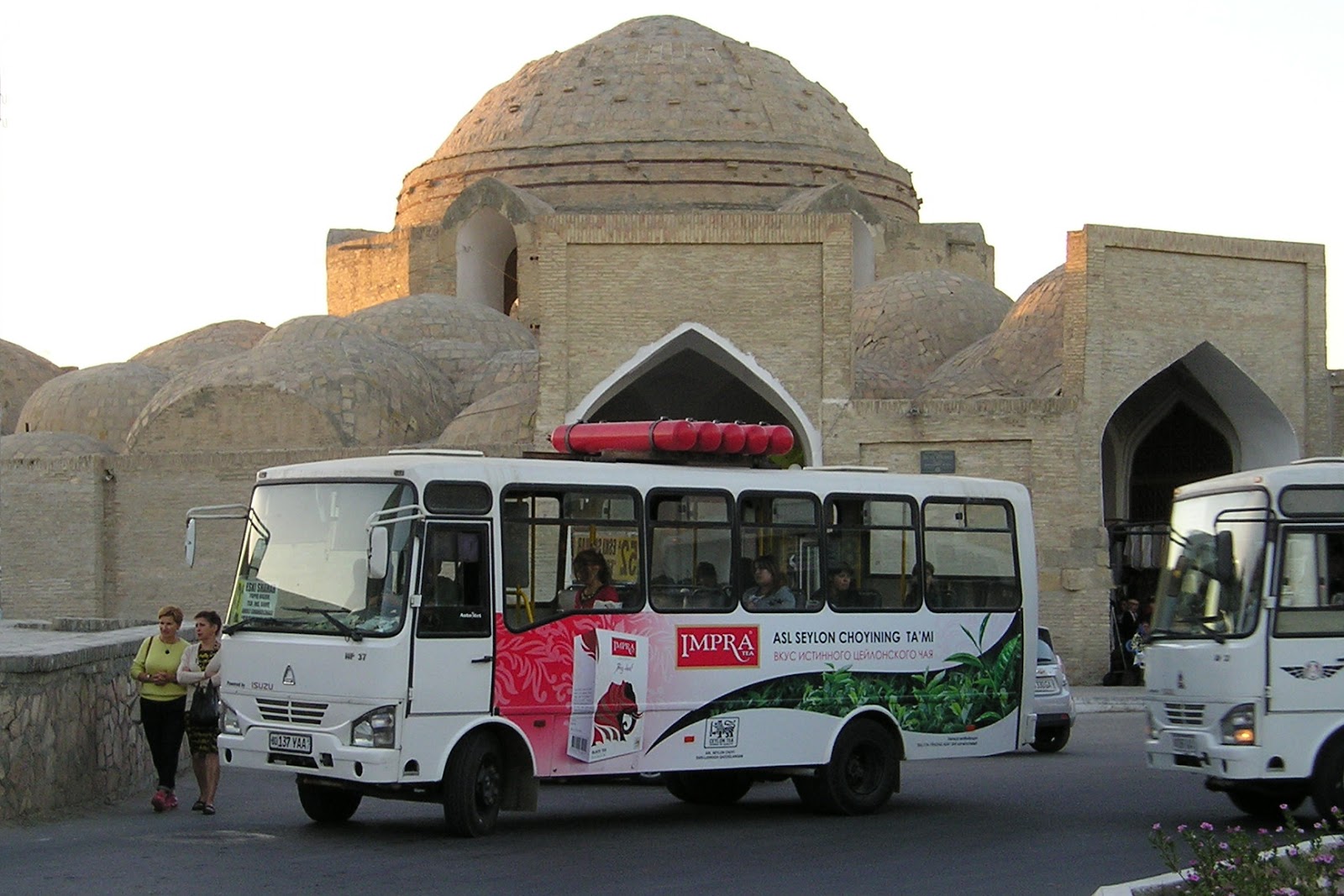
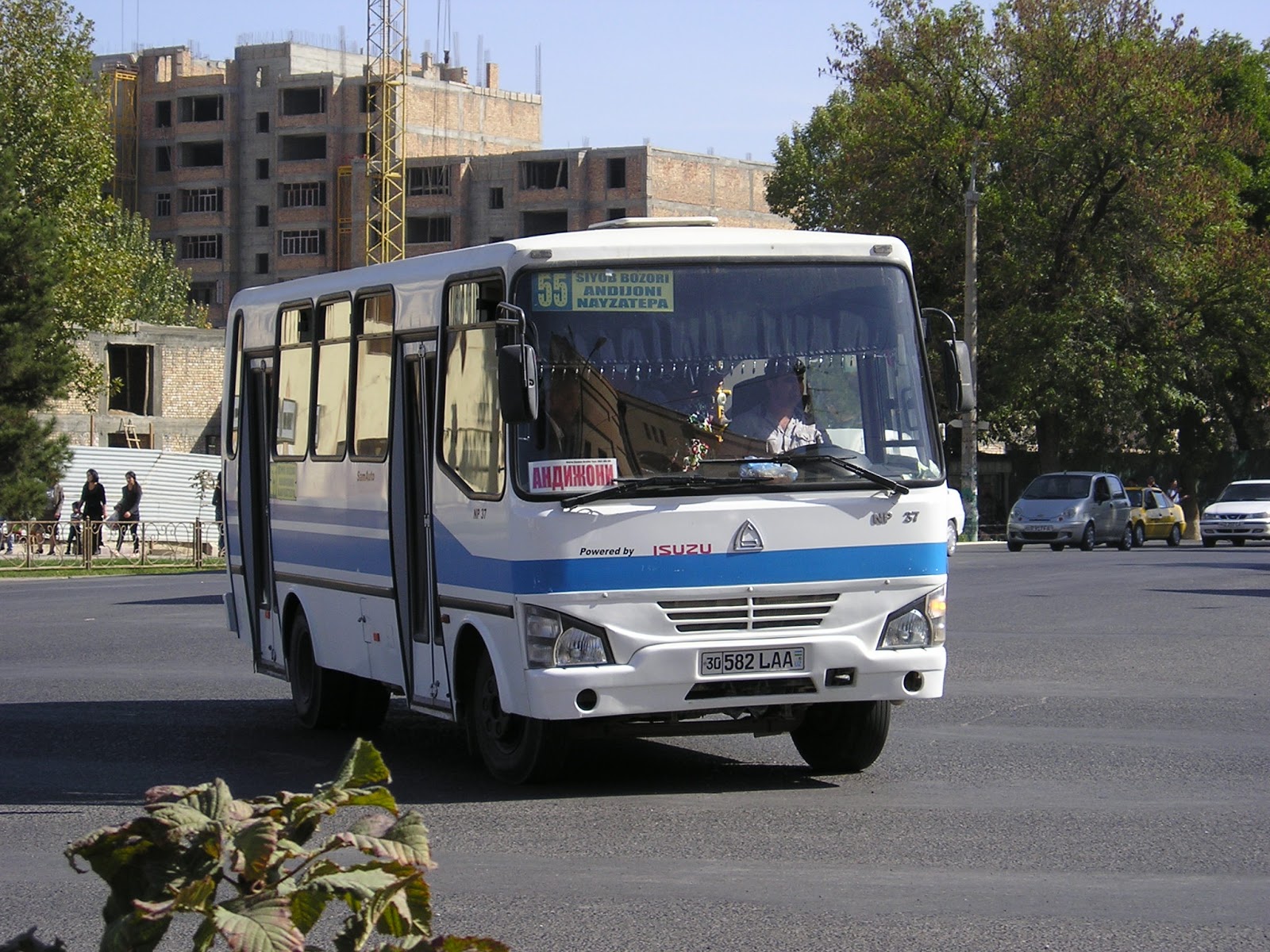
Most visitors start in Tashkent, the north west of the country and head south east. Travel by road/rail and air is relatively simple, if at times a little uncomfortable. All major cities have bus networks and there are plenty of intercity and tourist coaches. Until recently the majority of large buses and coaches were imports from Europe with evidence of much older vehicles originating from the USSR. Today the new coaches are mainly Chinese imports from the likes of Higer and Yutong, whilst the small urban buses tend to be a locally built derivative of the typical high floor Japanese truck/coach chassis. Samkochavto was set up as a joint Turkish/Uzbekistan venture in November 1996, producing vehicles in Samarkand, using engines provided by Isuzu. In 2006 Uzavtosanoat purchased the shares of its Turkish partner. Under the new ownership the trading name was changed to SamAuto LLC. To western eyes the vehicles may seem impractical for heavily utilised city services, but away from the major highways the local neighbourhood roads generally lack any form of hard surface. Much of the local transport runs on natural gas, with large gas tanks strapped precariously on the roofs of older vehicles.


954 GAA is a  Kässbohrer-Setra  S216HDS dating from the 1980s seen in the desert near Urgench. The reason given for using such old vehicles on incoming tourist service was the lack of robustness from the modern Chinese imports in coping with the rough desert roads. The Setra was very sound for it age but unfortunately the interior was in poor condition, with broken seat backs and vinyl covering the panels held on with staples.


The dual carriageway from the major city of Urgench (population 137,300) to the ancient walled town of Khiva is relatively straight and flat but distinguishable for its trolleybus route, the one and only in the country. The line is 31.3 km (19.4 mi) long and operated by Skoda 24Tr Irisbus vehicles bought in 2013. This is the only remaining section with the route having been cut back in 2008 from the airport. With a running time of around 1 hour 20 minutes, seven of the fleet of nine trolleybuses are required to maintain the advertised 25 minute frequency. The Khiva terminus was once a loop; the overheads are still in place but the road on what would be the exit is in such dire state that it is closed to all except pedestrians. As a consequence trolleys are required to reverse into the terminus.


Number 13 photographed in Khiva at sunset.  


Travelling south east you arrive at the ancient city and trading post of Bukhara (population 272,500).  Locally built Sam Auto (Samarkand Automobile Factory) minibuses with Isuzu engines are the backbone of city operations.


137 YAA an SAZ HC 40 B38D photographed at the Rue Mekhtar Ambar terminus in Bukhara, (note the gas tanks on the roof).   


Continuing 268km on to the architectural gem of Samarkand, (population 509,000), the highlight of any Uzbekistan visit. The city has its own bus operation Samarqandavtoyo' Lovchitrans. Services are frequent and always busy.


Also in Bukhara are three vehicles at either end of the age profile. Below is 327 JAA, I am assuming is an earlier version of the Sam Auto product.  


The final destination on route to the airport and flight home is the capital city of Tashkent with a population of 2,352,900. A city re-built in soviet style after a severe earthquake in 1966. The city has what would be regarded as a normal public transport system, including an effective metro, conventional bus network and extensive shared minibus service. Tashkent Public Transport System (Toshshakhartranskhizmat) is made up of 32 operators, employing 6192 staff of which 3560 are drivers and conductors. The fleet consist of 1350 buses; 27 Mercedes Benz 0345’s; 600 Mercedes Benz low floor Conecto’s; 684 Isuzu’s; 30 Mercedes Benz Uberland’s; 8 Hyundai’s and one MAN. In 2016 Toshshakhartranskhizmat carried 272m passengers. Recently GPS tracking has been fitted to most of the fleet.


Whilst 609 QAA and 824 AAA are current Chinese products from Higer Bus Co., Ltd. nd Xiamen Golden Dragon Bus Co., Ltd.   


Finally, for those not brave enough to venture aboard a service bus, there is always a city tour.


582 LAA Sam Auto SAZ HC 40 B38D with Isuzu engine is typical of the fleet. Being the major tourist centre of the country, coaches prominently feature in the city. 


In recent years Uzbekistan has implemented a development programme for passenger transport. New convenient regular routes have been launched, bus terminals and stations have been built, whilst others have been revamped.  Nearly 3,000 buses and 12,000 other passenger vehicles have been purchased in the last three years. The plans for the next five years envisage opening nearly 300 new routes. By 2021 it is anticipated there will be 1,600 suburban and long distance routes, plus 400 other services. Between 2017 and 2021 it is proposed to purchase 2,900 vehicles, plus 5,700 minibuses, the majority of which will be leased.


So if you love an alternative take on history, wonderful architecture and wish to cogitate about their economic stability, Uzbekistan with its great PCV scene is the place for you.  


754 BAA a Mercedes Benz 0302 negotiates the major five way junction at Shohi Zinda Kochasi/Rudakiy Kochasi whilst the traffic lights are out of action on a Sunday morning.  


Looking smart for its age is H656 BA a Mercedes Benz 0303 in the Registan coach park.   

428 WAA, Mercedes Benz Conecto at the Navoiy Shoh Ko'chasi interchange, over 100 are operated, all delivered in the last few years.  

399 FCA, is a Samkochavto (Sam Auto) built bus approaching the interchange.  

 014 WDA a local 'shared' bus collecting passengers in the bus station section of the interchange.   

101 UCA is operated by Aznur Travel using a Higer KLQ6119GS. 

Wednesday, 4 December 2019

Marrakech 2019


Marrakech was founded in 1062 by Yusuf ibn Tashfin, leader of the Moroccan Almoravid empire, and became the capital of that empire. Later the capital was moved to Fez and subsequently in 1911 to Rabat. Today, Marrakech is the fourth largest city in Morocco, after Casablanca, Fez and Tangier, with an urban area of 88.80 sq miles and a population of 953,305 and is capital of the mid south-western region of the country. It is the region’s commercial centre and transportation hub for the minerals that are extracted from the Atlas mountains. The city’s main economy is based on tourism as well as agricultural products and is also the headquarters of bus operator ALSA Morocco.


The majority of buses are Scania which are built as knock-down kits at Scania's factory in Katrineholm, for assembly and bodybuilding in Morocco. In 1999 Scania received its first major order from the city for the supply of L94IB city and inter-city chassis. Scania Maroc has a major service facility in Agadir.


Since 1999 ALSA, a subsidiary of the British based National Express Group, has managed the transport network in the city, and is now operating 42 city routes, three suburban services and the one line BRT route utilizing 257 vehicles. The main focus for the city network is around Bab Doukala, a one-way system featuring a park situated in the middle of a roundabout just outside the old Medina wall. Twenty-five services terminate or pass through this area, and it includes the northern terminus for the BRT. The Gare Routiere coach interchange is also located here. Additionally, ALSA is responsible for the city sightseeing franchise which it won in 2006 and when the contract was subsequently renewed in 2017, fully electric double-deckers were introduced. 


The city has two departure points for long distance express services. Independents depart from Gare Routiere Voyageurs  on Rue Bab Doukkala, located in the northwest of the city. The coach station consist of two areas, one is a traditional line of herringbone bays open to the elements and the second is a number of unusual undercover bays of dubious architectural design. The departure point for CTM and ALSA express services is from Rue Abou Bakr Seddiq, just south of the central railway station. Both coach stations and the railway station are served by the BRT line.


The BRT line is the first in Africa and commenced on 28 September 2017. ALSA operates services between 06.00 and 23.00 every 6 minutes at peak times and every 12 minutes off-peak. To use the service Moroccans pay 100 dirham (£7.90) per day and 150 dirham for two days, while foreigners have to pay 150 dirham per day and 200 dirham for two days.  A fleet of fifteen Dongfeng Yangtse Veryon G92 trolleybuses were delivered of which twelve are required to maintain the service: these buses cost 4 million dirham each (£316,000.00) and were financed by the Ministry of the Interior. The 12m long, partly low-floor, vehicles are equipped with batteries for off-wire operation (although no wire infrastructure is visible between Gueliz and the central station). The fleet is due to expand by the end of 2019, when ridership is forecasted to be 45,000 passengers a day.  Dongfeng Yangtse is a bus manufacturing company based in the central China city of Wuhan in Hubei province. Formerly known as the Wuhan Public Bus Factory, the company traces its roots back to 1929. They will supply 20 18m long trolleybuses in the near future. 


ALSA 9217, a Solaris Urbino 18 Hybrid on Avenue Mohammed V operating route 16 from the central Djemaa El Fna terminus to  Azzouzia - a suburb in the north west of the city.


Dongfeng Yangtse Veyron G92 trolleybus number 08 on the segregated roadway is approaching the Grand Poste intersection on Avenue Hassan 2 heading towards the Gueliz (Bab Doukala) terminus.

Scania with Tata Hispano Habit body passing through the Bab Er Robb arch on route 35 (Sidi Mimoun - Tahnaout).


ALSA 9293 a Scania about to depart on service 38 from the Bab Doukkala terminus to Bengeurir located in the north of the city.


On Avenue Mohammed V  a locally built Irizar body on Scania chassis operating route 1 Bab Doukkala to Arset El Bilk.


ALSA 9245 travelling along Rur Oqba Ben Nafaa on route 24 Mimoun to Taheslouht.


Travelling along the public road section of Avenue Hassan 2 parallel to the BRT is  a high floor Scania on suburban service 251 from Sidi Mimoum to Ghmat.


Gare Routiere Voyageurs outside departure bays with a line of independent express operators touting for trade. All the coaches carry locally built Irizar bodies.


The architecturally suspect design for the undercover departure bays at Gare Routiere Voyageurs.


Thursday, 27 June 2019

Sargeants Coaches


Sargeants on parade.


In deepest Herefordshire, tucked in a valley more familiar to Celts and Romans than modern day travellers, lies Kington which is a small town of 3200 souls and home to Sargeants Coaches.


As befits an operator of many years standing, the depot is very traditional, sitting alongside a public footpath and sharing a vehicle right-of-way with caravans using the adjacent campground. A single storey office fronts the depot with a maintenance shed immediately behind, then a yard and at the bottom is a steam cleaning ramp and wash area.


This is the type of depot I love as it brings back fond memories. No paved areas, just rough hardcore surface in-between a selection of various size potholes which are filled with rain water and a mixture of diesel and oil floating as if a flatten larva-lamp and hypnotic patterns gently drifting in the light breeze. Men in overalls that are coated in the grime of many days' labour are under well maintained vehicles, whilst others scrub and clean oblivious to the drenching they are receiving.


Small town operators with a loyal local staff are gradually becoming a rarity, may the survivors live long and prosper.


R399 EOS, new to Parks, Hamilton (KSK 950) and YIL 1720, new to Armchair (N713 CYC), both Volvo B10M-62 with Van Hool Alizee C53F bodies parked adjacent to the maintenance shed. 

W408 UCJ Optare Excel L1180 B43F was delivered new and now resides at the bottom of the yard close to the steam cleaning ramp.

The two guard dogs keep watch over Y877 PWT an Optare Solo M920 C31F, purchased new in 2001.

A line-up of Optare products.

YJ03 UMK DAF SDB250, Optare Spectra H47/27F new to Reading Buses in 2003.

YJ58 CFG, Optare Tempo X1200 B43F, the ex Optare demonstrator, gets a scrubbing.


YJ10 MHU Optare Solo M950 B31F originally delivered to Hatts in 2010 reverses out ready for the short two hundred yard drive into Kington bus station and the 13.10 departure on cross border route 461 to Llandrindod Wells.

FX03 ECC Mercedes Benz 1223L with Ferqei (Optare import) C39F body acquired from Hatts. 

(Never enter a depot without seeking permission and never board a vehicle unless invited to do so.)   

Wednesday, 30 January 2019

When the ships come in.


All aboard that's going ashore ~ Southampton cruise movements.


Yet another opportunity to look at the mass movement of passengers through the SOC area and one which is less obvious. For family reasons, during the summer of 2017 I have spent a great deal of time in Southampton, more than at any time since moving away thirty-one years ago. To make the most of this opportunity I planned, wherever possible, to coordinate these visits with days when there were major cruise ship movements.

Departing from bay 1 at Victoria Coach Station on Queen Mary 2 passenger transfer, Princess Coaches MA17 YJB, Scania K410EB4.


Southampton is Europe's largest 'turnaround' cruise ship port with 27.7% of the market, creating 11,000 (2014 figures) jobs in the south east region, with the total cruise ship industry estimated to be worth £1 billon to the UK economy. The city is home to the headquarters of Carnival UK, ultimate owners of P&O and Cunard. In 2016, 462 cruise ships and 1.8m passengers passed through the port. There is also an increasing market for the city from ships that call in as day visitors, giving the opportunity for shore excursions to Stonehenge, Salisbury, Winchester etc, whilst the city appears popular for shopping. The majority of ships whether on turnaround or visit arrive around 7am and depart between 4pm and 7pm the same day. 

Princess Coaches' drivers tend to use Mayflower Park for layovers. Front coach is DB09 PAB, Scania K340EB4 with Irizar C49Ft body. An unidentified cruise ship is moored in berth 101.
For many years the majority of local passenger and crew transfers were operated by Marchwood Motorways and this continued for quite some period after the Go-Ahead takeover. Passengers were shuttled between the various berths in both the eastern and western docks, and Southampton Central railway station, whilst the crew had a dedicated bus stop in Castle Way (the flag is still on the pole). This year the majority of local crew transfers were carried out by Princess Coaches using the coach bay in Harbour Parade as a terminus. This is also the location used for passengers making shore visits to the city centre. Various operators appear on passenger shuttles, by far the most prolific being Morton's of Little London, Basingstoke, using their fleet of three axial Volvo B9TL with either East Lancs of Optare Olympus CH61/39F bodies, ideally suited for this type of mass movement. Solent Coaches of Ringwood do local transfers using a pickup point in Castle Way between West Street and St Michael's Street, denoted by an 'A' board placed on the pavement. Solent Coaches regularly use three axial Neoplans and Volvos with Van Hool bodies, and these can often be found later in Hill Lane, operating King Edward VI school contracts.

Photographed 'resting' in the Herbert Walker Avenue coach bay, Solent Coaches Volvo B10M-62/Plaxton C52F body. New in 1997 to Eassons, Southampton. Previous registrations, DAZ5054 and WNR 63.
Other regular contract services include P&O crew transfers for those staff joining or leaving the ship in Southampton, and are operated by City Circle from Hayes in Middlesex. By far the largest operator into the port in terms of passenger numbers, vehicle size and fleet utilisation is Eavesway of Wigan. A familiar sight on the motorways of Britain, with their Van Hool TD921s, they have cornered the market in scheduled transfer services for all major cruise lines and ports. On behalf of Carnival Lines they operate four routes into Southampton: (a) Scotland and the North West, Glasgow, (03.30 departure, £138 return), via various pickup points, Blackpool, Liverpool, Stoke to Birmingham (10.15 departure, £75 return); (b) North East and Yorkshire, Newcastle (05.00 departure, £124 return), via Hull, Leeds, Northampton to Cherwell Valley Services (11am departure, £68 return); (c) North Wales, Bangor (05.15 depart, £115 return), via Abergele, to Chester (07.15 depart, £92 return), and finally (d) South Wales, Pont Abraham (07.45 depart, £92 return), via Cardiff to Swindon (12.00 depart, £72 return). Each service arrives into Southampton between 2.30pm and 3pm.

Resting between crew transfers in Herbert Walker Avenue, back to back City Circle coaches - a Neoplan and YT15 AUY, Scania K410EB6 with Irizar i6 C53Ft body.
The best time to view the comings and goings is between 2pm and 4pm on days when several ships are in port. This however will require a reasonable amount of walking and some luck, as four port gates are used, one in, one out for the eastern dock, one by Mayflower Park in the western dock and a second one near the Novotel. The distance between the furthest east and west is just under a mile. Sun is also a problem at all the gates, so try for an overcast day and, if you like coaches, you will love Southampton.

Returning to port from the Harbour Parade terminus, Morton's of Basingstoke Volvo B9TL with Optare Olympus H61/39F body. New to Imperial, Southall, London as YJ11 EMV.

A regular operator into the port is Crawley Luxury (Brown), West Sussex. BU14 SZK Mercedes Benz Tourismo. New to Chiltern Travel in 2014, exiting the dock gate onto Platform Road after dropping off at Queen Mary 2. The Queen Mary 2 is 149,215 tonnes, has 1253 crew and carries a maximum of 2695 passengers. 

All hands to the pump on busy days, First Bus Hampshire & Dorset Dennis Trident with East Lancs H49/30F body. New to First Bristol in 2000. Turning onto Town Quay after completing a city centre shuttle.

Unusual performer, Eavesway Travel Van Hool TDX21A CH52/5Ft, in an all over wrap for Nissan, laying over in Herbert Walker Avenue.

National Express Group, Clarkes of London. Mercedes Benz Tourismo C49Ft, new in 2010. Behind is P&O Azura, 115,055 tonnes with 900 cabins, 1226 crew and able to carry 3597 passengers.


Something of a rarity in private hire fleets, Acklams, Beverley YX16 NWH, Volvo B11RT with Plaxton Elite-i CH69/3Ft body turning into Town Quay.

Solent Coaches, Ringwood, 5505 ML, Neoplan N2216/3SHDL C61Ft. New in 2012 to Bennett, Uxbridge as MJ62 OMT. Entering Mayflower Roundabout returning excursion passengers to the ship.