Showing posts with label Isuzu. Show all posts

Monday, 22 June 2026

Ghardaia, Algeria.


Youyi manufactured bus passing the entrance to Ghardaia market. The window sign is saying 'Mashallah (ما شاء الله) means “what Allah has willed”. 


When you think of an oasis what comes to mind: Bing Crosby, Bob Hope on the Road to Morocco; French Foreign Legion in their white kepi with neck guard headgear; Maria Muldaur singing Midnight at the Oasis or a 1980’s Britpop band? Ghardaia is an oasis and none of the above would immediately come to mind. 376 miles from the capital Algiers and with a population of 93,423, it has palm trees and a water course and is set in the M’Zab valley surrounded by steep cliffs and miles of empty Sahara Desert. It is a modern-day commercial town which meets the needs of the five fortified settlements surrounding the valley and is home to Ibadi Muslim sect.

Surprisingly, for such a small town there is an extensive bus network stretching out into the desert communities under the auspice of ETUSG (Établissement de Transport Urbain et Suburbain de Ghardaïa). The main bus station is located in the Tagherdaït district, at the junction of Rue Emir Abdelkader and Avenue de L’A.L.N, and consists of two off-road parking areas with room for two lanes of buses in each. The five surrounding settlements are impregnable to public transport, and, in most cases, to any sort of vehicles other than motorbikes so buses terminate just outside at the main gates to the walls. Beni Isguen is the largest of these settlements. There are two distinct bus types, small TATA and Isuzu Ecobus of various ages operating in the town and large Higer or Sonacome-SNVI operating out of the valley.


The bus station at the junction of Rue Emir Abdelkader and Avenue de L’A.L.N. Only local buses now depart here. Long distance buses leave from a newer bus station on the edge of town.


The bus station just outside the main gate into Beni Isguen. Beni Isguen is a fortified settlement with defensive walls enclosing the entire community of 6800 residents, founded in 1347. The town, built on a steep hillside, features narrow streets winding between stone buildings with a central marketplace close to the main gate. Visitors are not permitted to enter the settlement without being accompanied by a guide from the community and are not permitted to remain after dark. 


Isuzu Ecobus arriving at the Ksar Tafilelt, the new town terminus. Ksar Tafilelt is a district of Bounoura, a commune of Ghardaïa. Land for the new town was purchased in 1997 and work began in 2000. The town planning replicates the older towns around Ghardaia but in a sustainable way, no concrete was used in construction, but streets are wider allowing for some vehicle movements. The town is occupied by Mozabites of the Ibadi Muslim sect.  


Higer KLQ6108GA on route 50, climbing out of Ghardaia on highway N1 towards New Metlili, a large recently developed town, and the airport. Other small communities are along the side of the highway giving the district a population of around 40,500. 


SNVI City at the Bounoura roundabout on the south-east side of the town at the junction of Avenue de L’A.L.N and the N1. The roundabout is a tourist attraction in itself, featuring a large mock sand castle at its centre. 


TATA manufactured bus in the city centre.

Higer KLQ6108G returning towards the city centre.

Higer KLQ6108G departing the city centre.


An SNVI 100L6 with all-over wrap for the war heroes in the city centre.  


Isuzu Ecobus Classic at rest by the oasis. 


Tuesday, 2 June 2026

Algiers


Photographed on the Bouvard Zighout Youcef, Tirsam TS9 operated by ETUSA (L'Entreprise de Transport Urbain et Suburbain d'Alger) and officially introduced into service in March 2026. 

Algiers is the capital and chief seaport of the People’s Democratic Republic of Algeria, population approximately 3.5m. Located along the Bay of Algiers and first settled by Phoenicians, it was later ruled by the Romans. The French took the city in 1830 and made it their headquarters for their African colonial empire. In World War II (1939–45), it became the Allied headquarters in northern Africa and, for a time, the provisional capital of France. The city centre is built on steep hillsides with narrow hairpin roads and many flights of pedestrian steps. A promenade, several kilometres long and dissected by the commercial dock area, provides a seaside feel. 19th and 20th century architecture give the city a cosmopolitan air, whilst the Casbah (the old walled quarters) harks back to an earlier time.  

The skyline is dominated by the Martyrs Memorial which was opened in 1982 to honour the 20th anniversary of Algeria’s brutal and bloody war for independence. The memorial rises 302 feet tall and is comprised of three soaring “palm leaves,” each punctuated at the base by a statue of a single Algerian soldier. At sea level the Great Mosque of Algeria, Africa's largest mosque, boasts the world's tallest minaret which dominates the landscape.

Mercedes‑Benz O345 with MCV 120 body operated by Tahkout, a specialist in education transport, although some routes have transitioned to public entities like ETUSA or the Transtev group.  Photographed at the Place de la Grande Poste which was built on the site of an Anglican church. The main post office was designed by Jules Voinot and Marius Toudoire, constructed in 1910 and is a fine example of French-designed, early 20th-century Moorish architecture.

Local bus services, tram and cable cars are managed by Urban and Suburban Transport Establishment of Algiers (ETUSA). As with many large cities, there are roadside terminus points although the city centre focal point for many services is the bus station at Gare routière Tafourah just off the promenade. The majority of buses departing are Isuzu Ecobus minibuses and Sonacome/SNVI. Route numbers 100-105 form the core services along the western coast corridor, 121-128 head south and east, and routes 129 and 130 also use the bus station. Some distance to the east is the express coach station, Gare Routiere Grandes Invalides Caroubier, in the commune of Hussein Dey and managed by The Société de Gestion des Gares Routières d'Algérie (SOGRAL). Next door is Caroubier Bus Station, the largest urban hub in Algiers. Route numbers from Caroubier are 140-148 and 150-151.

On 3rd May 2026 ETUSA launched 30 new bus routes from the following termini: Hussein Dey (1 route), Rouïba (1 route), Baraki (1 route), Chéraga (1 route), El Harrach (2 routes), Bir Mourad Raïs (4 routes), Draria (2 routes), Sidi Abdellah (6 routes), Bir Touta (2 routes), Zéralda (3 routes), Sidi ’hamed (1 route), Bab El Oued (1 route), and Cross‑District Lines (5 routes). Plus three routes that extend beyond Algiers. The launch of these new routes coincided with the delivery of the first batch of new Tirsam buses, the first of several thousand expected.

The city also has a single metro line currently being extended to the airport.

Shoukran to Rafik Cheraitia in whose footsteps I faithfully followed whilst showing me the city.

A line of Isuzu Ecobus minibuses and one Tata parked on Rue Hammadi Nacer.


A SNVI 38L6 is short front-engine bus. Photographed at the Memorial park on Avenue November 1st. 

Mercedes-Benz Conecto bus operated by ETUSA standing at the Station de Bus Audin on Rue Didouche Mourad. This bus terminus is the departure point for services 170-174 with destinations towards the west of the city centre. 

Mercedes-Benz Conecto bus operated by ETUSA passing the Botanical Garden Hamma. In 1832, Pierre Genty De Bussy, the Civil Intendant, and General Antoine Avisard, Interim Governor, decided to drain the marshes at the foot of the Arcades hill. The 32 hectares Botanical Garden of Hamma were created.

Mercedes-Benz Conecto bus operated by ETUSA on Rue Asselah Hocine.

Higer passing the Museum of Fine Arts on route 24. This bus is part of a new fleet of 102 buses received by ETUSA in April 2026 to modernize urban transport. The fleet includes 32 large capacity 100 passenger buses. The Museum of Fine Arts is one of the largest art museums in Africa. 

Express coaches in Gare Routiere Grandes Invalides Caroubier.

SONACOME/SNVI 100V8.  These buses are based on the Berliet PR100 and were built in Algeria by SONACOME and later SNVI between around 1979 and 2002. The bus is on the N11 (Rue d’ Angkor) heading back towards the city centre. The overhead cables are from the adjacent railway line.

Friday, 14 June 2024

Azerbaijan & Nakhchivan


BakuBus MMC 15599 (99·JU·284). BMC Procity 12 CNG, new in 2019. One of 510 in service with the operator. Operating service 125 from 28 May metro station to the southern suburb of Lokbatan, a distance of 21km with a 10-minute headway. Photographed on Neftchilar Avenue heading out of the city.


The Republic of Azerbaijan sits on the borders of Europe and Asia with a coastline on the Caspian Sea; land borders with the Republic of Dagestan, Iran, Georgia and Armenia; has the enclave of Nakhchivan. With a population of 10.2 million the capital is Baku, main language is Turkic and the currency is the manat (1 manat = 47p). This former part of the Soviet Union is now a ‘democratically elected one party state’, rich in gas and oil reserves.

The Nakhchivan Autonomous Republic is a land locked nation situated in the southwest end of the Lesser Caucasus and covers an area of 5,500 KM² with a population of 444,400. It has a 246km long border with Armenia; 204km with Iran and 11km with Turkey. Since the second Nagorno-Karabakh war of 2020 and the 2023 Azerbaijani offensive, the Republic is only accessible to foreigners by air. Biblically, Nakhchivan is said to be the resting place of the Prophet Noah and that the cleft peak of Mount Ilandag was carved out by Noah's Ark. The Republic is also considered one of the least polluted countries in the world, with no major industries and vast areas given over to mountains and national parks.


The capital of Azerbaijan, Baku, has a population of 2.62 million. The terrain is hilly, levelling out on the seafront with a 14km long promenade. The streets are often narrow, and the architecture is a mix of ancient, Soviet and spectacular modern. Public transport includes a two-line metro system, 70 city bus routes, 124 suburban routes, 6 minibus routes in the city and 17 in the suburbs; carries 350,000 passengers daily and is overseen by Baku Transport Agency (BTA). Tickets are purchased using the ‘BakkaKART’, a pre-loaded smart card. The municipal operator is BakuBus MMC with two bus garages, each has a capacity of 300 buses. Two large independents, Cinar Trans LLC and Khaliq Faiqoglu (part of the SAFA Holding group of companies) plus 41 small operators contribute about 2,168 buses to the network, with the minibuses, normally white, accepting only cash (0.30 manat in the city), payable before alighting. Passenger loadings are always heavy with services suffering from day long traffic congestion, and most routes continue to midnight and beyond. 
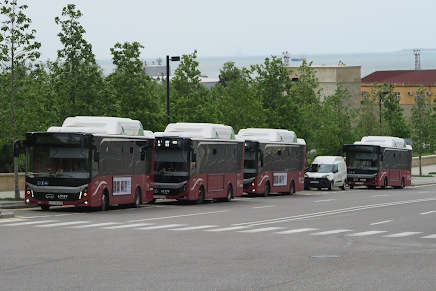

BakuBus MMC 67197 (77·JA·829) heads a line-up of four out of a total of 205 currently operational BMC Neocity 9M CNGs, new in 2022. The buses are lined-up at the Nizami Ganjavi Park terminus of route 10. Route 10 is a convoluted route east/west through the city centre, the western terminus being at the Zefir Shopping Mall. 


Baku’s public transport has seen huge investment and between 2015 and 2020, 603 medium and large-capacity buses were purchased, these included 300 buses bought in 2019. In 2020 115 Turkish built BMC buses were ordered, 80 were 12-meter long and 35 9-meter-long BMC Neocity. As a result of the Clean Bus Declaration (BUS2025), one BYD 12-meter electric bus was purchased in 2023. A second electric bus from China's ZhongTong Bus was purchased in 2024. Recently the Economy Ministry has signed an agreement with BYD to assemble vehicles locally. Major purchases have also been made by the two large independents, Cinar Trans LLC has invested in 150 new vehicles since 2017 and Khaliq Faiqoglu, who operate 300 buses (the blue buses in Baku) have received Otokar or Isuzu types for their city routes 18, 52, 61, 65, 79, 85, 96, 135 and 199.


BakuBus MMC 15406 (99·JB·291). BMC Procity 18 CNG, new in February 2020 and one of 20 in service. Photographed passing the architecturally amazing Heydar Aliyev Centre on route 13 towards the large park & ride/interchange site Mezhdunarodnyy avtovokzal.


Ganja is Azerbaijan’s second largest city (population 335,600) and owes much of its history to being on the original silk road. The city saw bombing by Armenian forces during the 2020 Nagorno-Karabakh war. Between 1955 and 2004 the city had an extensive trolleybus network. Today most routes are operated by mini and midibuses of various ages and from several manufacturers. Information on the network is limited, although ten routes were observed.

20·EY·910 Karsan ATAK operated by Azər Avtonəqliyyat in Ganja. The vehicle was new to Baku in 2018 and came to Ganja in October 2023. Photographed passing the Ganja branch of National Academy of Sciences of Azerbaijan on Shah Ismayil Khetayi Avenue.


Sheki is a small city on the slopes of the Greater Caucasus Mountains (population 68,460). There are 16 bus routes operated by minibuses (Marshrutkas) primarily of Mercedes Benz manufacture, the vast majority Mercedes 208D’s with the occasional 507D. Despite their age, these vehicles manage the hilly terrain with gusto: routes 11 and 17 climb to The Palace of the Sheki Khans situated at 800m above sea level, fully laden with passengers, showing little sign of their age. 


55·BJ·0882, PAZ-3205 operating route 22 in Sheki. Route 22 operates between the Olympic complex, bus terminal, hospital, theatre, old bazaar, caravansary, The Palace of the Sheki Khans, and children's hospital. The route climbs to over 800m on a steep incline. The bus is returning to the city centre passing the caravansary. 


Nakhchivan City (population 94,500) is the administrative centre for the Autonomous Republic. A small walkable city with wide boulevards, a result of Soviet planning, that provide a one-way system for the bus network. Until 2004 there was a trolleybus system consisting of three routes. Today the city buses are mostly Isuzu and King Long midibuses whilst suburban buses are fleets of Mercedes 208D/408D’s. The main bus station is in the north of the city at the junction of Dilgam Pishavari Road and the M7, whilst the out-of-town minibuses congregate around the central market in the south of the city. 

O·014·MR a MAZ 206 in Nakhchivan city. The only one of this type seen during the visit.


Ordubad is the second largest city in Nakhchivan, built on a hillside close to the Iranian border and is a mixture of modern and medieval architecture. The local bus service travels up Emin Sadliq Road, with the primary objective to get residents up the steep hill from the bottom of town using Mercedes 208D/408D’s.

75·BA·039, a KAvZ 3270. KAvZ is a subsidiary of the GAZ Group. Photographed in Ordubad, Nakhchivan, now acting as a motorhome.


Throughout the visit it was difficult to identify coach operators as most vehicles carried no signwriting. They were however quite modern vehicles. The current favoured large vehicle type is the Neoplan Cityliner, whilst slightly older vehicles mainly consist of Mercedes Benz Travelgo’s. New midi-coaches are TEMSA and all smaller coaches Mercedes Benz Sprinters.

99·JB·060, 99·JB·010, two of the numerous Neoplan Cityliners seen throughout Azerbaijan. These are parked at Heydar Aliyev Centre.


Azerbaijan is investing heavily in transport infrastructure. The recent agreement between the country and its neighbour Armenia to open a transit corridor between the two parts of Azerbaijan will see both road and rail links established. The investment in buses seen in Baku might spread to the hinterland. For now  Azerbaijan remains a hidden treasure.


Faiqoğlu 1044 (99·JM·354), Anadolu Isuzu Citiport 12, new in 2016 and one of 55 in service. The bus is arriving at the Yaşıl Bazar terminus on Khatai Avenue, Baku.


GAZ-3221, 55·BE·099 heading up hill on route 11 - new bazaar; bus terminal; old bazaar; caravansary; The Palace of the Sheki Khans; children's hospital; Olympic complex. Despite its age and heavy passenger loading, the vehicle makes the climb to over 800m with aplomb.   

75·AF·186, a PAZ-672 looking smart for its age, in the car park of the Dusdagh Salt Mines’ Hospital, Nakhchivan. The PAZ 672 was produced between 1968 and 1989.

77·CF·108 has a Sunsundegui Sideral body possibly on an Iveco chassis. Parked at the Qobustan State Reserve on a school trip.

                                                                                            Bus and Coach World